Evolution has taught us to solve problems by fight or flight. It’s natural then that we apply the same tactics to our psychological problems, but it’s a strategy that doesn’t always work.
I listened intently and heard a sound. It was Tina. Or not really Tina. The gleaming eyes of the wolf stared back at me from the darkest corner of the storeroom. God help me, I didn’t know what to do. If we’d been in the village, I would have jumped on the horse, ridden straight to Kazem Khan’s and cried, “Come quick! The wolf is back!”
But we weren’t in the village and Kazem Khan wasn’t here.
So I took a step backwards, as I had seen Kazem Khan do, and called softly to my sister, “Go and get the Holy Book!” She snatched the book off the mantel and handed it to me.
I knelt by the storeroom door, turned to the wild beast, kissed the cover, closed my eyes, opened the book to a page and began to chant.
As I recited the sura, I quietly took one step forward, then another. Reciting all the while, I held out my hand to her and saw the light go out in the wolf’s eyes. I went on until I felt Tina’s hand seek mine in the darkness. “Come, Tina, come!” I whispered. “Let’s go eat.” She struggled to her feet and then walked into the living room.
I look out my window and I see the wolf running through the Dutch polder.
Let it run, let it go, let the wolf lose its way on this new ground, so it will never be able to find its way back to Tina.’
Kader Abdollah. My Father’s Notebook. Translated from Dutch by Susan Massotty.
‘Probably the single biggest evolutionary advantage of human language was the ability to anticipate and solve problems. This has enabled us not only to change the face of the planet, but to travel outside it. The essence of problem-solving is this:
Problem = something we don’t want.
Solution = figure out how to get rid of it, or avoid it.
This approach obviously works well in the material world. A wolf outside your door? Get rid of it. Throw rocks at it, or spears, or shoot it. Snow, rain, hail? Well, you can’t get rid of those things, but you can avoid them, by hiding in a cave, or building a shelter. Dry, arid ground? You can get rid of it, by irrigation and fertilisation, or you can avoid it, by moving to a better location. Problem solving strategies are therefore highly adaptive for us as humans (and indeed, teaching such skills has proven to be effective in the treatment of depression). Given this problem solving approach works well in the outside world, it’s only natural that we would tend to apply it to our interior world; the psychological world of thoughts, feelings, memories, sensations, and urges. Unfortunately, all too often when we try to avoid or get rid of unwanted private experiences, we simply create extra suffering for ourselves. For example, virtually every addiction known to mankind begins as an attempt to avoid or get rid of unwanted thoughts and feelings, such as boredom, loneliness, anxiety, depression and so on. The addictive behaviour then becomes selfsustaining, because it provides a quick and easy way to get rid of cravings or withdrawal symptoms.
Russell Harris. Embracing Your Demons: an Overview of Acceptance and Commitment Therapy
The night is still young, and as I lie here in bed looking up into the darkness, a darkness so black that the ceiling is invisible, I begin to remember the story I started last night. That’s what I do when sleep refuses to come. I lie in bed and tell myself stories. They might not add up to much, but as long as I’m inside them, they prevent me from thinking about the things I would prefer to forget. Concentration can be a problem, however, and more often than not my mind eventually drifts away from the story I’m trying to tell to the things I don’t want to think about. There’s nothing to be done. I fail again and again, fail more often than I succeed, but that doesn’t mean I don’t give it my best effort.
I put him in a hole. That felt like a good start, a promising way to get things going. Put a sleeping man in a hole, and then see what happens when he wakes up and tries to crawl out. I’m talking about a deep hole in the ground, nine or ten feet deep, dug in such a way as to form a perfect circle, with sheer inner walls of dense, tightly packed earth, so hard that the surfaces have the texture of baked clay, perhaps even glass. In other words, the man in the hole will be unable to extricate himself from the hole once he opens his eyes. Unless he is equipped with a set of mountaineering tools—a hammer and metal spikes, for example, or a rope to lasso a neighboring tree—but this man has no tools, and once he regains consciousness, he will quickly understand the nature of his predicament.’
Paul Auster. Man in the Dark.
‘Imagine that you’re placed in a field, wearing a blindfold, and you’re given a little tool bag to carry. You’re told that your job is to run around this field, blindfolded. That is how you are supposed to live life. And so you do what you are told. Now, unbeknownst to you, in this field there are a number of widely spaced, fairly deep holes. You don’t know that at first—you’re naive. So you start running around and sooner or later you fall into a large hole. You feel around, and sure enough, you can’t climb out and there are no escape routes you can find. Probably what you would do in such a predicament is take the tool bag you were given and see what is in there; maybe there is something you can use to get out of the hole. Now suppose that the only tool in the bag is a shovel.
So you dutifully start digging, but pretty soon you notice that you’re not out of the hole. So you try digging faster and faster. But you’re still in the hole. So you try big shovelfuls, or little ones, or throwing the dirt far away or not. But still you are in the hole. All this effort and all this work, and oddly enough the hole has just gotten bigger and bigger and bigger. Isn’t that your experience? So you come to see me thinking, “Maybe he has a really huge shovel—a gold-plated steam shovel.” Well, I don’t. And even if I did I wouldn’t use it, because digging is not a way out of the hole—digging is what makes holes. So maybe the whole agenda is hopeless—you can’t dig your way out, that just digs you in.’
Hayes, S. C., Strosahl, K. D., and Wilson, K. G. Acceptance and commitment therapy: An experiential approach to behavior change.
It is only those who know neither an inner call nor an outer doctrine whose plight truly is desperate; that is to say, most of us today, in this labyrinth without and within the heart. Alas, where is the guide, that fond virgin, Ariadne, to supply the simple clue that will give us the courage to face the Minotaur, and the means to find our way to freedom when the monster has been met and slain?”
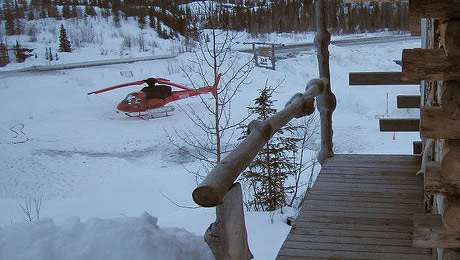
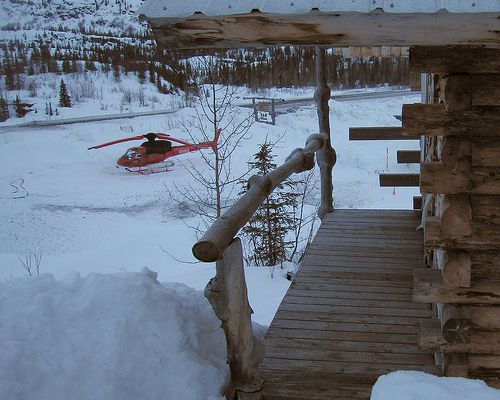
Suppose you are out skiing, and when you got off the lift, you mention to the person who rode up the lift with you that you plan to ski down to the lodge where you’re going to meet up with some friends for lunch. “No problem” this person replies, and suddenly he waves to a helicopter above, that upon his signal, swoops you up and speedily deposits you at the ski lodge. You protest vigorously, but the pilot is incredulous. He says, “What’s your beef, my friend? It was you who said the objective was to get from the summit down to the lodge!”
The helicopter pilot would have a point if getting to the lodge were the only issue. If it is, flying down the slope achieves exactly what skiing down achieves. Both have you start at the top and end up at the lodge. The helicopter even has notable advantages: you don’t get cold, or tired, or wet, for example.
There is only one problem with this. The goal of getting to the lodge was meant to structure the process of skiing. That process was the true “goal.”
You have to value “down” over “up” or you can’t do downhill skiing. Aiming at a specific goal (the lodge) allows you to “orienteer” one way to go down the hill. But the true goal is just to ski, not reaching the goal (the lodge).
In precisely the same way, the true goal of goals is to orient you toward your values so you can live a valued life, moment by moment. A successful ACT patient put it this way toward the end of therapy: “I just want to do this because that’s what I want my life to be about. It’s not really about any outcome. I want to be alive until I’m dead.” Goals can help you do exactly that. But be careful! Your mind will often claim that the true goal is the goal itself (after all, evaluating outcomes is what this organ evolved to do), and it will suggest that you should cut corners (like violate your integrity, or ignore other valued aspects of your life) to get there. That defeats the whole purpose, and if you succumb to cutting corners, accomplishing your goals will only mock you.
* In a series of posts I call mythology Monday, I look at quotes from the work of mythologist Joseph Campbell and consider them alongside extracts from books and papers on acceptance and commitment therapy (ACT) and related publications.
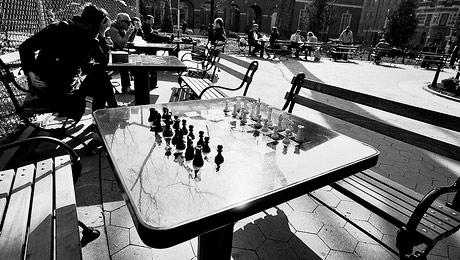
Our thoughts can be like a chess game, a constant battle between two sides. We could also choose not to always play those pieces and be the chessboard instead.
I set out the chess board. I filled a pipe, paraded the chessmen and inspected them for French shaves and loose buttons, and played a championship tournament game between Gortchakoff and Meninkin, seventy-two moves to a draw, a prize specimen of the irresistible force meeting the immovable object, a battle without armor, a war without blood, and as elaborate a waste of human intelligence as you could find anywhere outside an advertising agency.”
The Chessboard Metaphor, a central ACT intervention, connects the client to the distinction between content and the observing self:
Imagine a chessboard that goes out infinitely in all directions. It’s covered with black pieces and white pieces. They work together in teams, as in chess—the white pieces fight against the black pieces. You can think of your thoughts and feelings and beliefs as these pieces; they sort of hang out together in teams too. For example, “bad” feelings (like anxiety, depression, resentment) hang out with “bad” thoughts and “bad” memories. Same thing with the “good” ones. So it seems that the way the game is played is that we select the side we want to win. We put the “good” pieces (like thoughts that are self-confident, feelings of being in control, etc.) on one side, and the “bad” pieces on the other. Then we get up on the back of the black horse and ride to battle, fighting to win the war against anxiety, depression, thoughts about using drugs, whatever. It’s a war game. But there’s a logical problem here, and that is that from this posture huge portions of yourself are your own enemy. In other words, if you need to be in this war, there is something wrong with you. And because it appears that you’re on the same level as these pieces, they can be as big or even bigger than you are—even though these pieces are in you. So somehow, even though it is not logical, the more you fight the bigger they get. If it is true that “if you are not willing to have it, you’ve got it,” then as you fight these pieces they become more central to your life, more habitual, more dominating, and more linked to every area of living. The logical idea is that you will knock enough of them off the board that you eventually dominate them—except that your experience tells you that the exact opposite happens. Apparently, the white pieces can’t be deliberately knocked off the board. So the battle goes on. You feel hopeless, you have a sense that you can’t win, and yet you can’t stop fighting. If you’re on the back of that black horse, fighting is the only choice you have, because the white pieces seem life threatening. Yet living in a war zone is no way to live.
The soil above the seed is hard to push through, but this very handicap, this resistance to the soil, forces the young sprout to gather strength for the battle. Where shall it get this additional strength? Instead of fighting ineffectively against the topsoil, the seed sends out delicate roots to gather more nourishment. Thus the sprout at last penetrates the hard soil and wins through to the sun. According to science, a single thistle needs ten thousand inches of root to support a thirty- or forty-inch stem. You can guess how many thousands of facts a dramatist must unearth to support a single character. By way of parable, let a man represent the soil; in his mind we shall plant a seed of coming conflict: ambition, perhaps. The seed grows in him, though he may wish to squelch it. But forces within and without the man exert greater and greater pressure, until this seed of conflict is strong enough to burst through his stubborn head. He has made a decision, and now he will act upon it. The contradictions within a man and the contradictions around him create a decision and a conflict. These in turn force him into a new decision and a new conflict.”
The bold and truly epoch-making writings of the psychoanalysts are indispensable to the student of mythology; for, whatever may be thought of the detailed and sometimes contradictory interpretations of specific cases and problems, Freud, Jung, and their followers have demonstrated irrefutably that the logic, the heroes, and the deeds of myth survive into modern times. In the absence of an effective general mythology, each of us has his private, unrecognized, rudimentary, yet secretly potent pantheon of dream. The latest incarnation of Oedipus, the continued romance of Beauty and the Beast, stand this afternoon on the corner of Forty-second Street and Fifth Avenue, waiting for the traffic light to change.” Joseph Campbell. The Hero with a Thousand Faces
‘As a human being, you are the central figure in the universal hero’s mythic journey, the fairy tale, the Arthurian quest. For men and women alike, this journey is the trajectory between birth and death, a human life lived. No one escapes the adventure. We only work with it differently.’ Jon Kabat-Zinn. Wherever You Go, There You Are: Mindfulness Meditation in Everyday Life
* In a series of posts I call mythology Monday, I look at quotes from the work of mythologist Joseph Campbell and consider them alongside extracts from books and papers on acceptance and commitment therapy (ACT) and related publications.
One of the first tasks of the writer, I have found, and not the easiest, is forgiveness: You must forgive yourself for writing crap first drafts. Perform whatever ritual of absolution you have to, pray to whatever cruel god or gods you have to, but do that for yourself. Only once you’ve forgiven yourself can you begin the serious work of writing, which isn’t writing at all. It’s revising.
‘Most clients have a hard time with forgiveness, because it sounds like a change in judgment or evaluation. It sounds like ‘I used to think you were wrong, but now I’ve changed my mind.’ Worse, it may appear to be equivalent to emotional avoidance: excusing, denying, or forgetting old angers and hurts. But the word forgive itself suggests a more positive way to approach this difficult topic: We can take it to mean ‘give that which came before’—literally, fore-giving. It means repairing what was lost. Gift comes from the Latin gratis, or free. In that sense, fore-giving is not earned: it is free. However, the gift of forgiveness is not a gift to someone else. Giving what went before is most particularly not a gift to the wrongdoer. It is a gift to oneself.’
For fifteen years or more, I was carrying out a literary exercise of a quite different kind: this was the making up of a continuous “story” about myself, a sort of diary existing only in the mind. I believe this is a common habit of children and adolescents. As a very small child I used to imagine that I was, say, Robin Hood, and picture myself as the hero of thrilling adventures, but quite soon my “story” ceased to be narcissistic in a crude way and became more and more a mere description of what I was doing and the things I saw. For minutes at a time this kind of thing would be running through my head: “He pushed the door open and entered the room. A yellow beam of sunlight, filtering through the muslin curtains, slanted on to the table, where a match-box, half-open, lay beside the inkpot. With his right hand in his pocket he moved across to the window. Down in the street a tortoiseshell cat was chasing a dead leaf,” etc. etc. This habit continued until I was about twenty-five, right through my non-literary years. Although I had to search, and did search, for the right words, I seemed to be making this descriptive effort almost against my will, under a kind of compulsion from outside. The “story” must, I suppose, have reflected the styles of the various writers I admired at different ages, but so far as I remember it always had the same meticulous descriptive quality.
If you find yourself entangled in a “logical” but sad story about your life, and why things have to be the way they are, write down the normal story, then take all the descriptive facts and write the same exact facts into a different story. Repeat until you feel more open to new possibilities with your history.
Was Cathy from Wuthering Heights practising mindfulness all those years ago? Was she able to quietly reflect on her faults when people were critical of her?
At fifteen she was the queen of the country-side; she had no peer; and she did turn out a haughty, headstrong creature! I own I did not like her, after infancy was past; and I vexed her frequently by trying to bring down her arrogance: she never took an aversion to me, though.
Over the years, quite a few people have called me arrogant (especially my wife). I used to deny it, discount it, or counter-attack with a criticism about the other person (I won’t tell you what I called my wife). These days, I usually respond differently (alas, not always); I tend to pause, notice and reflect, considering whether there is something valid in the criticism; to look with openness and curiosity at the way I’ve been behaving. And if the criticism is valid, I consider: what’s working, what’s not working, and what could I do differently? Finally I (often, but not always) respond mindfully, acting on my values – which usually means apologizing for my arrogance and expressing myself more respectfully.






















 thefictiontherapist.com