The fundamental text of the Hindu tradition is, of course, the Bhagavad Gītā; and the four basic yogas are described. The word yoga itself, from a Sanskrit verbal root yuj, meaning ‘to yoke, to link one thing to another,’ refers to the act of linking the mind to the source of mind, consciousness to the source of consciousness; the import of which definition is perhaps best illustrated in the discipline known as knowledge yoga, the yoga, that is to say, of discrimination between the knower and the known, between the subject and the object in every act of knowing, and the identification of oneself, then, with the subject. I know my body. My body is the object. I am the witness, the knower of the object. I, therefore, am not my body.’ Next: ‘I know my thoughts: I am not my thoughts.’ And so on: ‘I know my feelings, I am not my feelings.’ You can back yourself out of the room that way. And the Buddha then comes along and adds: ‘You are not the witness either. There is no witness.’ So where are you now? Where are you between two thoughts? That is the way known as jñāna yoga, the way of sheer knowledge.”
‘Recall something that happened last summer. Anything that comes to mind is fine. Remember what was happening then. Remember where you were and what was happening. See if you can see, hear, and smell, just as you did last summer. Don’t remember the scene as if you were someone else looking at the scene from the outside. Do it from inside the body of the person called “you” who was there, looking out from behind your eyes. Close your eyes and take a few moments to imagine this scene.
Now notice as you remember the scene that you were there. There was a person behind those eyes, just as there is now. And although many things have happened since last summer, notice too that there is an essential continuity between the part of you that is aware of what you are aware of now, and the part of you that was aware of what you were aware of back then. We call that person the “observer-self.”
* In a series of posts I call mythology Monday, I look at quotes from the work of mythologist Joseph Campbell and consider them alongside extracts from books and papers on acceptance and commitment therapy (ACT) and related publications.
Frustrated by rejection, new authors can feel like failures. Their feelings of impatience, even anxiety, can lead to bad career decisions. Or to even give up on their dream.
Frustrated newcomers can begin to do silly things to get the attention of publishing pros. A friend who edits romances for a major paperback publisher told me how at one conference an overeager author followed her into the ladies room—right into an empty stall—in order to pitch her manuscript. Did it work? No way!
Typically, authors express their anxiety in more subtle ways.
What is this anxiety really about? It can be experienced as the desperate feeling that no one in book publishing cares a damn about you or your manuscript. One can feel it as anger over slush piles (stacks of unrequested, waiting-to-be-read manuscripts), fury over long response times, frustration with uncaring editors or agents—one can even begin to resent the success of others. What began as bliss can turn to utter misery.
I would like to suggest that these overt signs of anxiety actually mask fears of a more fundamental sort. One is the fear of failure, the terrifying possibility that one has wasted years of one’s life. A second is the fear of humiliation—so many expectations to fulfill!
Especially one’s own!
Most fundamental of all, I believe, is the anxiety that derives from the need for validation. Above all things, writers want acceptance. They long to be judged worthy of publication. They want to be assured that they are not crazy. They need to know that all this time and effort have not been for nothing. If the breaking-in period becomes too lengthy or too frustrating, most writers will sooner or later get desperate. Some will start to avoid the whole process, refusing to push themselves. Others will keep at it doggedly but cynically, losing all excitement and hope.
That is too bad, because that kind of burnout can lead to ill-considered career decisions. And, these days, there is little room for error in the big, bad world of book publishing.
James, a single, 31-year-old Caucasian male, is an aspiring actor and screenwriter…It became clear during the initial treatment sessions that it was his dissatisfaction with the current state of his life that was most distressing for James. He was frustrated with the lack of progress in his career and was struggling with thoughts of not having accomplished enough to this point in his life and fears of being a “failure.”
Through a series of direct experiential exercises in session, James gradually became less emotionally reactive to the word “failure.” For example, when presented with the word “failure” written on a flash card, James reported wanting to rip up the card and throw it in the trash. The therapist then asked James whether he was willing to put the card in his lap, simply read it, let it be, and have the card touch him as a thought. James agreed and was surprised to notice that he could do this without getting tangled up in what the card says. He was also willing to take the card with him over the next week everywhere he went. In addition, James and his therapist did an exercise in which they rapidly repeated the word “failure” for approximately 30 seconds while observing what happens to the quality of the word when doing so. James reported that after saying the word repeatedly “failure” was reduced to merely a string of almost unrecognizable sounds and he could see that it was ultimately just a word.
Exercises such as this helped James to become a better observer of his own thinking and he learned that he does not have to take his thoughts, even historically difficult thoughts, so seriously and do what they say. For example, during the course of treatment James completed his screenplay and put together a team of actors to present his screenplay to an audience for the very first time, despite experiencing occasional thoughts of failing throughout the process.
We all adopt different masks depending on where we are and who we’re with. Behind them all is an individual who can observe each of the different roles we play.
To become—in Jung’s terms—individuated, to live as a released individual, one has to know how and when to put on and put off the masks of one’s various life roles. ‘When in Rome, do as the Romans do,’ and when at home, do not keep on the mask of the role you play in the Senate. But this, finally, is not easy, since some of the masks cut deep. They include judgement and moral values. They include one’s pride, ambition, and achievement. They include one’s infatuations. It is a common thing to be overly impressed by and attached to masks either some mask of one’s own or the mana-masks of others. The work of individuation, however, demands that one should not be compulsively affected in this way. The aim of individuation requires that one should find and then learn to live out of one’s own center, in control of one’s own for an against. And this cannot be achieved by enacting and responding to any general masquerade of fixed roles.”
‘The practice of personal development usually focuses on changing your thinking. You’re told to think positively, optimistically, bigger and differently; to let go of negative thoughts and think yourself happy. The belief is that if you change your thoughts you change yourself, implying that you are your thoughts. Mindfulness offers a different perspective. Note that the word ‘personal’ comes from the Latin persona, meaning ‘mask’ (referring to the masks actors used in theatre to represent different characters) and ‘development’ comes from the old French word desveloper, meaning ‘to unveil’. So, interestingly, personal development is about unveiling your mask to reveal your true self. You wear different masks every day: mother or father, husband or wife, teacher or writer, footballer or driver. But underneath all that is another dimension that’s easily missed – the fact that you’re able to observe all these different roles implies that you’re separate from them. We call this the observer self.’
* In a series of posts I call mythology Monday, I look at quotes from the work of mythologist Joseph Campbell and consider them alongside extracts from books and papers on acceptance and commitment therapy (ACT) and related publications.
If your deepest beliefs drive your writing, they will not only keep your work from being contrived but will help you discover what drives your characters. You may find some really good people beneath the packaging and posing—people whom we, your readers, will like, whose company we will rejoice in. We like certain characters because they are good or decent—they internalize some decency in the world that makes them able to take a risk or make a sacrifice for someone else. They let us see that there is in fact some sort of moral compass still at work here, and that we, too, could travel by this compass if we so choose.”
‘Defining a valued direction produces a more consistent compass heading to direct action during the storms of life, when waves of emotion crash and the screaming minds of the wind blast. Anyone who has engaged in mindfulness meditation for any period of time is aware of how fickle and changeable emotions and thoughts can be. However, values tend not to change so rapidly over time. If the therapist can help clients describe their most basic values for their life, clients can contact a source of stability in an often-chaotic landscape of changing thoughts and feelings. Once clarified, stated, and committed to, values can be like a lighthouse, providing direction during dark psychological nights and story situations.’
The bold and truly epoch-making writings of the psychoanalysts are indispensable to the student of mythology; for, whatever may be thought of the detailed and sometimes contradictory interpretations of specific cases and problems, Freud, Jung, and their followers have demonstrated irrefutably that the logic, the heroes, and the deeds of myth survive into modern times. In the absence of an effective general mythology, each of us has his private, unrecognized, rudimentary, yet secretly potent pantheon of dream. The latest incarnation of Oedipus, the continued romance of Beauty and the Beast, stand this afternoon on the corner of Forty-second Street and Fifth Avenue, waiting for the traffic light to change.” Joseph Campbell. The Hero with a Thousand Faces
‘As a human being, you are the central figure in the universal hero’s mythic journey, the fairy tale, the Arthurian quest. For men and women alike, this journey is the trajectory between birth and death, a human life lived. No one escapes the adventure. We only work with it differently.’ Jon Kabat-Zinn. Wherever You Go, There You Are: Mindfulness Meditation in Everyday Life
* In a series of posts I call mythology Monday, I look at quotes from the work of mythologist Joseph Campbell and consider them alongside extracts from books and papers on acceptance and commitment therapy (ACT) and related publications.
One of the first tasks of the writer, I have found, and not the easiest, is forgiveness: You must forgive yourself for writing crap first drafts. Perform whatever ritual of absolution you have to, pray to whatever cruel god or gods you have to, but do that for yourself. Only once you’ve forgiven yourself can you begin the serious work of writing, which isn’t writing at all. It’s revising.
‘Most clients have a hard time with forgiveness, because it sounds like a change in judgment or evaluation. It sounds like ‘I used to think you were wrong, but now I’ve changed my mind.’ Worse, it may appear to be equivalent to emotional avoidance: excusing, denying, or forgetting old angers and hurts. But the word forgive itself suggests a more positive way to approach this difficult topic: We can take it to mean ‘give that which came before’—literally, fore-giving. It means repairing what was lost. Gift comes from the Latin gratis, or free. In that sense, fore-giving is not earned: it is free. However, the gift of forgiveness is not a gift to someone else. Giving what went before is most particularly not a gift to the wrongdoer. It is a gift to oneself.’
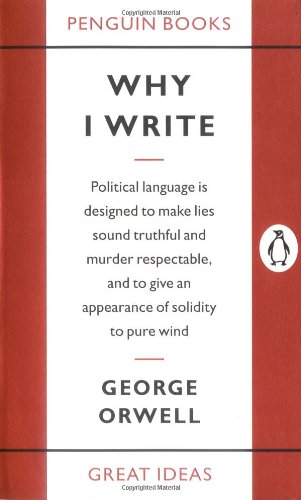
For fifteen years or more, I was carrying out a literary exercise of a quite different kind: this was the making up of a continuous “story” about myself, a sort of diary existing only in the mind. I believe this is a common habit of children and adolescents. As a very small child I used to imagine that I was, say, Robin Hood, and picture myself as the hero of thrilling adventures, but quite soon my “story” ceased to be narcissistic in a crude way and became more and more a mere description of what I was doing and the things I saw. For minutes at a time this kind of thing would be running through my head: “He pushed the door open and entered the room. A yellow beam of sunlight, filtering through the muslin curtains, slanted on to the table, where a match-box, half-open, lay beside the inkpot. With his right hand in his pocket he moved across to the window. Down in the street a tortoiseshell cat was chasing a dead leaf,” etc. etc. This habit continued until I was about twenty-five, right through my non-literary years. Although I had to search, and did search, for the right words, I seemed to be making this descriptive effort almost against my will, under a kind of compulsion from outside. The “story” must, I suppose, have reflected the styles of the various writers I admired at different ages, but so far as I remember it always had the same meticulous descriptive quality.
If you find yourself entangled in a “logical” but sad story about your life, and why things have to be the way they are, write down the normal story, then take all the descriptive facts and write the same exact facts into a different story. Repeat until you feel more open to new possibilities with your history.
Was Cathy from Wuthering Heights practising mindfulness all those years ago? Was she able to quietly reflect on her faults when people were critical of her?
At fifteen she was the queen of the country-side; she had no peer; and she did turn out a haughty, headstrong creature! I own I did not like her, after infancy was past; and I vexed her frequently by trying to bring down her arrogance: she never took an aversion to me, though.
Over the years, quite a few people have called me arrogant (especially my wife). I used to deny it, discount it, or counter-attack with a criticism about the other person (I won’t tell you what I called my wife). These days, I usually respond differently (alas, not always); I tend to pause, notice and reflect, considering whether there is something valid in the criticism; to look with openness and curiosity at the way I’ve been behaving. And if the criticism is valid, I consider: what’s working, what’s not working, and what could I do differently? Finally I (often, but not always) respond mindfully, acting on my values – which usually means apologizing for my arrogance and expressing myself more respectfully.
Lots of the people I meet on courses say that they’re waiting till their kids grow up, they’re waiting till they retire till they have time, and that’s when they’ll start their novel. My advice has been consistent for the twenty-odd years I’ve been teaching creative writing: don’t wait, there’s never a perfect time. Do it now.
‘As soon as you have to face any sort of challenge, your mind will come up with a whole list of reasons not to do it: ‘I’m too tired’, ‘It’s too hard’, ‘I’ll only fail’, ‘It’s too expensive’, ‘It’ll take too long’, ‘I’m too depressed’ etc. And that’s okay, as long as we see these reasons for what they are: excuses.’




























 thefictiontherapist.com