The battlefield is symbolic of the field of life, where every creature lives on the death of another. A realization of the inevitable guilt of life may so sicken the heart that, like Hamlet or like Arjuna, one may refuse to go on with it. On the other hand, like most of the rest of us, one may invent a false, finally unjustified, image of oneself as an exceptional phenomenon in the world, not guilty as others are, but justified in one’s inevitable sinning because one represents the good. Such self-righteousness leads to a misunderstanding, not only of oneself but of the nature of both man and the cosmos. The goal of the myth is to dispel the need for such life ignorance by effecting a reconciliation of the individual consciousness with the universal will. And this is effected through a realization of the true relationship of the passing phenomena of time to the imperishable life that lives and dies in all.’
Joseph Campbell. The Hero with a Thousand Faces
‘Metaphorically, the distinction between the function of a psychological disorder and the form it takes in one’s life can be likened to someone standing in a battlefield fighting a war. The war is not going well. The person fights harder and harder. Losing is a devastating option; but unless the war is won, the person fighting it thinks that living a worthwhile life will be impossible. So the war goes on.
Unknown to that person, however, is the fact that, at any time, he or she can quit the battlefield and begin to live life now. The war may still go on, and the battlefield may still be visible. The terrain may look very much as it did while the fighting was happening. But the outcome of the war is no longer very important and the seemingly logical sequence of having to win the war before beginning to really live has been abandoned.’
Steven C. Hayes and Spencer Smith. Get Out of Your Mind and into Your Life: The New Acceptance and Commitment Therapy.
* In a series of posts I call mythology Monday, I look at quotes from the work of mythologist Joseph Campbell and consider them alongside extracts from books and papers on acceptance and commitment therapy (ACT) and related publications.
After seven days of NaNoWriMo, many writers, like their heroes, will be facing their own obstacles. The key is to be flexible as you follow your path and achieve your ultimate goal.
All heroes encounter obstacles on the road to adventure. At each gateway to a new world there are powerful guardians at the threshold, placed to keep the unworthy from entering. They present a menacing face to the hero, but if properly understood, they can be overcome, bypassed, or even turned into allies. Many heroes (and many writers) encounter Threshold Guardians, and understanding their nature can help determine how to handle them.
Christopher Vogler. The Writer’s Journey: Mythic Structure for Writers
In the process of engaging in life-goal directed activities, clients inevitably encounter barriers. Most of the time, they are related to anxiety-related concerns that literally seem to hold clients back. An important recurrent task for therapists … is to help clients handle barriers to committed action and focus on making and keeping action commitments and on recommitting to action after they have broken a commitment. The focus is on teaching clients how to move with potential barriers rather than try to overcome or push through them. Therapists constantly encourage clients to stay with difficult situations, unpleasant feelings, thoughts, and other anxiety-related barriers to valued living by practicing mindful acceptance and defusion skills. The major goal here is to help clients develop more flexible patterns of behavior when relating with the stimuli, events, and situations that elicit fear or anxiety.
Georg H. Eifert, John P. Forsyth, Joanna Arch, Emmanuel Espejo and David Langer. Acceptance and Commitment Therapy for Anxiety Disorders: Three Case Studies Exemplifying a Unified Treatment Protocol.
We can sometimes focus too closely on following a particular plan while a more flexible moment-to-moment approach can be more effective and help to get more done.
It wasn’t impossible to see a whole show on this scale, but it was difficult. It took work. You had to be systematic, go aisle by aisle, moving up the hall in a zigzag, giving every stand some time but not so much time that it diminished the time given to others. That used to be my approach, but I found that route planning and time management occupied more of my thoughts that the content of the show itself. I was lost in the game of trying to see every stand, note every new product and expose myself to every scrap of stimuli – the show as a whole left only a shallow track in my memory. In being systematic, I saw only my own system. Completism was blindness; it yielded only a partial view.
So I threw away my diligent systems and timetables and started to truly explore. Today was typical of my current method of not having a method – I would strike out into the centre of the hall, ignoring all pleas and distractions, and from there walk without direction. I would try to drift, to allow myself to be carried by the current and eddies of the hall, thinking only in the moment, watching and following the people around me. Beyond that, I tried to think as little as possible about my aims and as much as possible about what was in front of me at any given time. I would give myself to the experience.
Will Wiles. The Way Inn.
‘Present-moment awareness is the process of bringing flexible and deliberate attention to one’s experience as it happens. Clients are encouraged to maintain attention on experiences in the moment and to dispassionately observe these experiences, rather than falling into content about events of the past or fears and expectations about the future. Through this process, ACT promotes ongoing nonjudgmental contact with both psychological and environmental events as they occur, strengthening more direct and immediate interaction with experience and undermining the effects of language. The goal is for clients to experience the world more directly so that their behavior is more flexible and consistent with the values they hold.
Jill A. Stoddard and Niloofar Afari. The Big Book of ACT Metaphors: A Practitioner’s Guide to Experiential Exercises & Metaphors in Acceptance & Commitment Therapy
Symbols are only the vehicles of communication; they must not be mistaken for the final term, the tenor, of their reference. No matter how attractive or impressive they may seem, they remain but convenient means, accommodated to the understanding. Hence the personality or personalities of God—whether represented in trinitarian, dualistic, or Unitarian terms, in polytheistic, monotheistic, or henotheistic terms, pictorially or verbally, as documented fact or as apocalyptic vision—no one should attempt to read or interpret as the final thing. The problem of the theologian is to keep his symbol translucent, so that it may not block out the very light it is supposed to convey. “For then alone do we know God truly,” writes Saint Thomas Aquinas, “when we believe that He is far above all that man can possibly think of God.” And in the Kena Upanishad, in the same spirit: “To know is not to know; not to know is to know.” Mistaking a vehicle for its tenor may lead to the spilling not only of valueless ink, but of valuable blood.’
Joseph Campbell. The Hero with a Thousand Faces
‘Some spiritual and religious traditions are among the best-documented sources of physical and psychological health, particularly the more experiential, accepting, and mystical practices such as meditation and prayer. This is not surprising, because these cultural traditions were among the first to emerge after human language really began to evolve into the elaborate symbolic system we have today. Yet psychotherapists often attack spiritual and religious traditions as if they were inherently toxic to an individual’s autonomy and psychological health.
The reasons for this skepticism are understandable. It is known that rigid and punitive religious systems are toxic to human health. There are dramatic examples of harmful social control and dogma in religion (e.g., cult suicide, ethnic cleansing). Often, clients who seek out psychotherapy are likely to be among those who have been harmed. But we need to be less arrogant and more open to aspects of human culture that are helpful.
In this larger context, ACT is one small effort to solve the psychological problems language has created. That is “the work” we have before us, and it is perhaps the most important psychological task we face as a species. If we as psychotherapists take on this burden, we need to look again at the many honorable traditions (religious, spiritual, mystical, therapeutic) that have attempted to address human suffering and try to filter out what works from what does not.’
Steven C. Hayes, Kirk D. Strosahl and Kelly G. Wilson. Acceptance and Commitment Therapy: An Experiential Approach to Behavior Change.
* In a series of posts I call mythology Monday, I look at quotes from the work of mythologist Joseph Campbell and consider them alongside extracts from books and papers on acceptance and commitment therapy (ACT) and related publications.
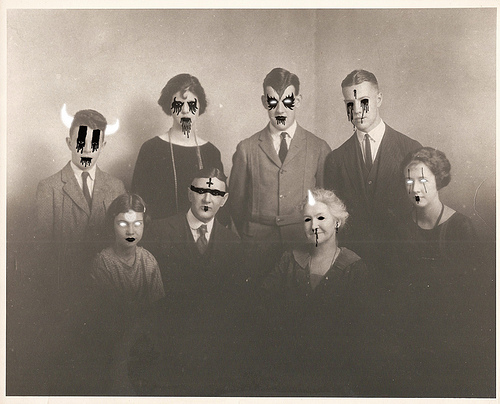
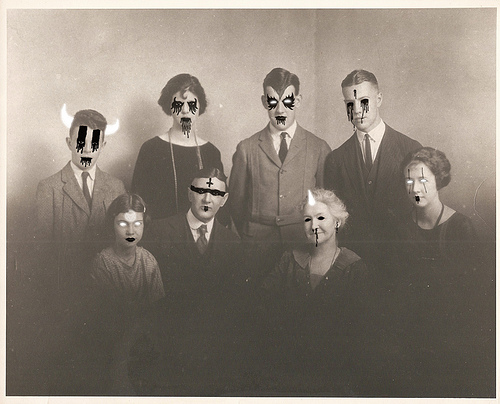
Demons don’t only exist in Halloween stories or scary movies. They can appear in all of us, stopping us from making progress in life. Until we accept them.
‘In films such as Tightrope, Lethal Weapon, Angel Heart, and The Morning After, the detective himself became the psycho, suffering from a wide variety of modern maladies sexual obsession, suicidal impulse, traumatic amnesia, alcoholism. In these films the key to justice became the cop’s psychoanalysis of himself. Once the detective came to terms with his inner demons, apprehending the criminal was almost an afterthought.
This evolution was a telling statement about our changing society. Gone was the day when we could comfort ourselves with the notion that all the crazy people were locked up, while we sane people were safely outside the asylum walls. Few of us are so naive today. We know that, given a certain conjunction of events, we too could part company with reality. These Psycho-Thrillers spoke to this threat, to our realization that our toughest task in life is self-analysis as we try to fathom our humanity and bring peace to the wars within.’
Robert McKee. Story: Substance, Structure, Style, and the Principles of Screenwriting
‘I don’t want to live surrounded by demons!’ Well, I’m sorry to be the bearer of bad news, but you already are. And those demons will keep showing up, again and again, as soon as you start to take your life in a valued direction. Why so? Again, it all stems back to evolution. Remember, the mind of our ancestors had one overriding imperative: ‘Don’t get killed!’ And an important factor in not getting yourself killed is to get to know your environment. The better you know the terrain and the local wildlife then, obviously, the safer you are; whereas venturing into unknown territory exposes you to all sorts of exotic dangers. So if one of our ancestors decided to explore a new area, his mind would go into a state of red alert. ‘Look out!’ ‘Be careful!’ ‘Could be a crocodile in that pond or a leopard in the bushes!’ And thanks to evolution, our modern minds do the same, only far more extensively.
Thus, as soon as we start to do something new, our mind will start warning us: ‘You might fail’, ‘You might make a mistake’, ‘You might get rejected.’ It warns us with negative thoughts, with disturbing images or bad memories, and with uncomfortable feelings and sensations. And all too often we let these warnings stop us from taking our lives in the direction we really want.’
It’s normal that your minds drifts off from time to time. If it does, it can help to recognise the thought and even give it a name as you return to the present moment.
Moody returned to the present with a jolt, and saw that Thomas Balfour was still looking at him, with an expression of intrigued expectation upon his face.
‘I beg your pardon,’ Moody said, in confusion. ‘I believe I must have drifted off into my own thoughts—for a moment—’
‘What were you thinking of?’ said Balfour.
What had he been thinking of? Only the cravat, the silver hand, that name, gasped out of the darkness. The scene was like a small world, Moody thought, possessed of its own dimensions. Any amount of ordinary time could pass, when his mind was straying there. There was this large world of rolling time and shifting spaces, and that small, stilled world of horror and unease; they fit inside each other, a sphere within a sphere. How strange, that Balfour had been watching him; that real time had been passing—revolving around him, all the while—
‘I wasn’t thinking of anything in particular,’ he said. ‘I have endured a difficult journey, that is all, and I am very tired.’
Eleanor Catton. The Luminaries.
‘Inevitably, there will be times when you get caught up in your thoughts. You may start daydreaming, or you may get trapped in your psychological pain. You may think about what you had for breakfast, what time the kids are due home from school, what movie you want to watch that night, or an ex-girlfriend you haven’t seen in years. As you know, your mind is extremely adept at creating thought. It’s likely you’ll find when you sit quietly that it seems as if your mind’s already natural talents have been amplified. You may have millions of thoughts flowing through your mind, and it’s likely you’ll get caught in them from time to time.
When this happens, simply notice that it has happened, and try to bring yourself back to the present moment and your observing self. Note that you have been in a thought and then return to the here and now.
One technique that is particularly effective to use while sitting is to label your thoughts. As you watch your thoughts pass before your mind’s eye, you may say, “I am having the thought that I had eggs for breakfast,” or, “I am having the feeling that I am sad.” It is also useful to note when you have drifted off, and even the thought that you have drifted off with: “I have been daydreaming about my ex-girlfriend. I am having the thought that I have been daydreaming.”
This can be particularly effective while you sit, because it is brief but still allows you to notice your thoughts, feelings, and bodily sensations as they come and go.’
Steven Hayes and Spencer Smith. Get out of your mind and into your life: the new acceptance and commitment therapy.
The Greek myth of Orpheus and Eurydice, and hundreds of analogous tales throughout the world, suggest, as does this ancient legend of the farthest East, that in spite of the failure recorded, a possibility exists of a return of the lover with his lost love from beyond the terrible threshold. It is always some little fault, some slight yet critical symptom of human frailty, that makes impossible the open interrelationship between the worlds; so that one is tempted to believe, almost, that if the small, marring accident could be avoided, all would be well. In the Polynesian versions of the romance, however, where the fleeing couple usually escape, and in the Greek satyr-play of Alcestis, where we also have a happy return, the effect is not reassuring, but only superhuman. The myths of failure touch us with the tragedy of life, but those of success only with their own incredibility. And yet, if the monomyth is to fulfill its promise, not human failure or superhuman success but human success is what we shall have to be shown.’
Joseph Campbell. The Hero with a Thousand Faces
‘You have only so much time on this earth, and you don’t know how much. The question “Are you going to live, knowing you will die?” is not fundamentally different than these questions: “Are you going to love, knowing you will be hurt?” Or, “Are you going to commit to living a valued life knowing you will sometimes not meet your commitments?” Or, “Will you reach for success knowing you will sometimes fail?” The potential for pain and the sense of vitality you gain from these experiences go together. If your life is truly going to be about something, it helps to look at it from the perspective of what you would want the path your life leaves behind to mean.’
Steven C. Hayes and Spencer Smith. Get Out of Your Mind and Into Your Life: The New Acceptance and Commitment Therapy.
* In a series of posts I call mythology Monday, I look at quotes from the work of mythologist Joseph Campbell and consider them alongside extracts from books and papers on acceptance and commitment therapy (ACT) and related publications.
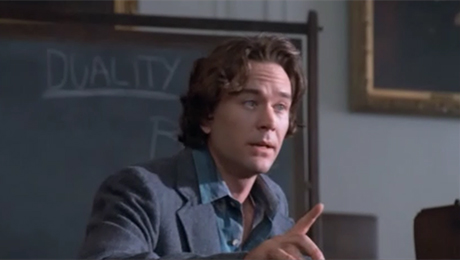
We can all benefit from taking the time to listen to our inner voices. Writers, especially, need to free those inner voices to remove inhibitions and write honestly.
The Dark Half. Directed by: George A. Romero. Writers: Stephen King (novel), George A. Romero (screenplay). Starring: Timothy Hutton.
‘Learning mindfulness (like life in general) will always present difficulties and obstacles. Perhaps you’re pretty nasty to yourself through excessive self-criticism when things don’t work out how you want them to. The way to deal with this harsh inner voice is to listen to it, give it space to unfurl and bring to it a sense of curiosity in a gentle, warm way.’
Shamash Alidina and Joelle Jane Marshall. Mindfulness Workbook for Dummies.
Love can be intoxicating, especially in the early stages of the relationship. Later, when reality kicks in and the intensity cools, it’s the perfect time to develop a deeper, more meaningful love.
Human beings,” I inhale my win’s nutmeg steam, “are walking bundles of cravings. Cravings for food, water, shelter, warmth; sex and companionship; status, a tribe to belong to; kicks control, purpose; and so on, all the way down to chocolate-brown bathroom suites. Love is one to satisfy some of these cravings. But love’s not just the drug: it’s also the dealer. Love wants love in return, am I right? Like drugs, the highs look divine, and I envy the users. But when the side effects kick in – jealousy, rages, the grief, I think, Count me out. Elizabethans equated romantic love with insanity. Buddhists view it as a brat throwing a tantrum at the picnic of the calm mind.”
David Mitchell. The Bone Clocks.
‘What few people realize is that an authentic, loving, meaningful relationship typically only develops once the honeymoon phase is over (another fact the songwriters, poets, and pop stars seem oblivious to). In the honeymoon phase, it’s as if you’re on a drug that intoxicates you and plays with your senses. When you’re high on it, your partner seems wonderful. But you’re not seeing reality; you’re merely seeing a drug-induced fantasy. And only when the drug wears off do you see your partner as he really is. And you suddenly realize that the knight’s shining armor is covered in rust spots, and his white horse is really a gray donkey. Or the maiden’s pure silk dress is only cheap nylon, and her long golden locks are really a wig. Naturally this comes as a bit of a shock. But herein lies the opportunity to build an authentic intimate relationship between two people who see each other as they really are. And as this relationship develops, there will be new feelings of love—perhaps not as intense or intoxicating, but infinitely richer and more fulfilling.’















 thefictiontherapist.com