Ernest Hemingway in the moment

A writer has to learn to feel the present moment in order to reproduce the sounds, actions and emotions for the reader.

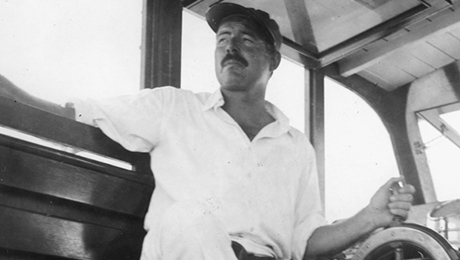
Hemingway on his boat the Pilar
Hemingway on his boat, the Pilar

Watch what happens today. If we get into a fish see exactly what it is that everyone does. If you get a kick out of it while he is jumping remember back until you see exactly what the action was that gave you that emotion. Whether it was the rising of the line from the water and the way it tightened like a fiddle string until drops started from it, or the way he smashed and threw water when he jumped. Remember what the noises were and what was said. Find what gave you the emotion, what the action was that gave you the excitement. Then write it down making it clear so the reader will see it too and have the same feeling you had.’

Ernest Hemingway. Monologue to the Maestro: A High Seas Letter.

‘To allow ourselves to be truly in touch with where we already are, no matter where that is, we have got to pause in our experience long enough to let the present moment sink in; long enough to actually feel the present moment, to see it in its fullness, to hold it in awareness and thereby come to know and understand it better. Only then can we accept the truth of this moment of our life, learn from it, and move on.’

Jon Kabat-Zinn. Wherever You Go, There You Are

Let your panic attack pass by

When a panic attack strikes, it can be better to give it the space and air it needs, just as the sky gives space to a storm until it passes.

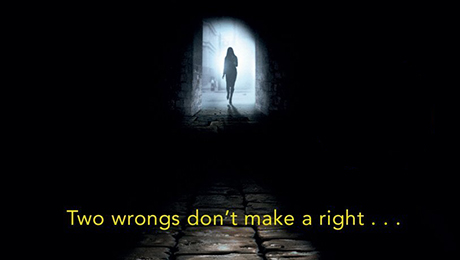
Apple Tree Yard by Louise Doughty‘So in total, you’ve been working in or visiting the Borough of Westminster for, what, around twelve years? Longer?’

‘Longer probably,’ I say, and the moment starts building then, there, a profound sense of unease located somewhere inside me, identifiable as a slight clutching of my solar plexus. I diagnose it in myself even as I am baffled by it.

‘So,’ she says, and her voice becomes slow, gentle. ‘It would be fair to say that with all that commuting and walking from the Tube and lunch hours and so on, that you are very familiar with the area?’

It is building. My breath begins to deepen. I can feel that my chest is rising and falling, imperceptibly at first, but the more I try to control myself, the more obvious it becomes. The atmosphere inside the court tightens, everyone can sense it. The judge is staring at me. Am I imagining it, or has the jury member in the pink shirt on the periphery of my vision sat up a little straighter, leaned forward in his seat? All at once, I dare not look at the directly. I dare not look at you, sitting in the dock.

I nod, suddenly unable to speak. I know that in a few seconds, I will start to hyperventilate. I know this even though I have never done it before.
The barrister’s voice is low and sinuous, ‘You’re familiar with the shops, the cafés…’ Sweat prickles the nape of my neck. My scalp is shrinking. She pauses. She has noted my distress and wants me to know that I have guessed correctly: I know where she is going with this line of questioning, and she knows I know. ‘The small side streets…’ She pauses again. ‘The back alleyways…’

And that is the moment. That is the moment when it all comes crashing down.

I am hyperventilating openly now, breathing in great deep gulps. My defence barrister – poor Robert – is staring at me, puzzled and alarmed.

Louise Doughty. Apple Tree Yard

‘The mind is home to our thought processes, and with its perceptions we create our world. When panic occupies and consumes our thoughts, it can take over and hold us hostage. Panicky thoughts race and swirl about, and the common result is feeling overwhelmed by a sense of impending doom. These thoughts may send us to the emergency room believing that we’re having a heart attack.

These thoughts can paralyze us so much that we are unable to get out of the house. These thoughts can make us break out in a cold sweat and begin to hyperventilate just before we give a speech.

As a way to work with panic, perhaps this metaphor will be helpful: As you learn to sit back and just experience the coming and going of your mind states, you can be like the sky giving space to a storm. It is the virtue of the sky, which is made of air, to give as much space as a storm needs—and in the end, as a result of having that space, the storm eventually dissipates. In the same vein, as you give space to the storms of panic, acknowledging what’s present in the body and mind and letting it be, it too will gradually dissipate, recede, or fade away.

Stormy mind states are here for a while and then they leave. Where they came from and where they go is often difficult to comprehend, but what’s most important is to know that they are here and that they are governed by the laws of change.’

Bob Stahl and Wendy Millstine. Calming the Rush of Panic: A Mindfulness-Based Stress Reduction Guide to Freeing Yourself from Panic Attacks and Living a Vital

How to deal with self-criticism

Self-criticism is part of what the mind does. Don’t ignore your inner censor. Listen, smile, and make peace with those thoughts.

Still Writing by Dani ShapiroIt helps to think of that inner censor as a beloved but annoying friend who has moved in for the duration. That friend is never going away. So you make peace with your inner censor. You say some version of, thanks very much for sharing, and then move on, past that censoring voice, and into your work.”

Dani Shapiro in an interview with Salon.com, talking about her book Still Writing: The Perils and Pleasures of a Creative Life.

‘Learning mindfulness (like life in general) will always present difficulties and obstacles. Perhaps you’re pretty nasty to yourself through excessive self-criticism when things don’t work out how you want them to. The way to deal with this harsh inner voice is to listen to it, give it space to unfurl and bring to it a sense of curiosity in a gentle, warm way.

I used to be very self-critical of everything I did. When I first practised yoga, for example, I thought about how bad I was at doing the poses. The voice telling me I’m bad at yoga comes back occasionally, but now I simply notice it and usually smile when I hear it. The negative thought usually dissipates quickly after that and I and I can carry on with my yoga (which I am now better at through steady practice!).’

Shamash Alidina and Joelle Jane Marshall. Mindfulness Workbook For Dummies

ACT on life’s hard choices

We have to make choices in life, and we learn from acceptance and commitment therapy that the freedom to choose is liberating. The failure to choose, says poet Diane Wakoski, is greed.

Greed: Pt. 8, 9, 11 by Diane WakoskiBut pick and choose.
Robot or Man. Machine- or hand-made,
You cannot have both.
Greed, I keep reminding you,
is the failure to choose. The unwillingness to pick one thing over
another. Wealth or simplicity; you cannot have both.

Diane Wakoski. Greed: Pt. 8, 9, 11

‘Life is hard. Life is also many other things. Ultimately your life is what you choose to make it. When the word-machine dominates, life works one way. When the verbal evaluative side of you is but one source of input, life works differently. The choices themselves aren’t always easy, but finding the freedom to choose is a liberating experience. It’s your life. It is not the word-machine’s—even though (of course) it tells you otherwise.’

Steven C. Hayes and Spencer Smith. Get Out of Your Mind and Into Your Life: The New Acceptance and Commitment Therapy

Let go of your grudge

Compassion neutralises toxic feelings, which is why this child doesn’t hold a grudge against his mother.

The Expats by Chris Pavone

‘Mommy, I have a new best friend,’ Ben said, apropos of nothing, his voice light-filled and carefree. He didn’t care he’d just been yelled at, fifteen seconds earlier. He didn’t hold a grudge against his mother.

‘That’s great! What’s his name?’

‘I don’t know.’

Of course not: little children know it doesn’t matter what you call a rose.

Chris Pavone. The Expats: A Novel

‘Does holding a grudge promote your health and wellbeing? For many people it does not, and you may begin to understand that at the very least it is more skillful to work on neutralizing these strong feelings that can be so toxic to your being. You can begin by sending compassion to yourself and then wisely reflecting upon reconciliation and considering that reconciliation is really for your benefit and not the other person’s. You may even begin to see more clearly that the causes of people’s hurting one another are fear and unawareness and that perhaps neither you nor the difficult person is “bad,” merely unaware and scared.’

Bob Stahl and Wendy Millstine. Calming the Rush of Panic: A Mindfulness-Based Stress Reduction Guide to Freeing Yourself from Panic Attacks and Living a Vital

The self-fulfilling prophesy of failure

How our own thoughts of failure can lead to a self-fulfilling prophesy.

Literature example: How to Get Filthy Rich In Rising Asia. Mohsin HamidYour teacher did not want to be a teacher. He wanted to be a meter reader at the electric utility. Meter readers do not have to put up with children, work comparatively little. And what is more important, have greater opportunity for corruption and are hence both better off and held in higher regard by society. Nor was becoming a meter reader out of your teachers reach. His uncle worked for the electric utility. But the one position as meter reader this uncle was able to facilitate went, as all things most desirable in life invariably went, to your teacher s elder brother.

So your teacher, who narrowly failed his secondary school final examination but was able to have the results falsified, and with his false results, a bribe equivalent to sixty percent of one years prospective salary, and a good low-level connection in the education bureaucracy in the form of a cousin, secured only the post he currently occupies. He is not exactly a man who lives to teach. In fact he hates to teach. It shames him. Nonetheless he retains a small but not non-existent fear of losing his job, of somehow being found out, or if not losing his job then at least being put in a position where he will be forced to pay yet another, and indeed larger bribe in order to retain it, and this fear, augmented by his sense of abiding disappointment and his not unfounded conviction that the world is profoundly unfair, manifests itself in the steady dose of violence he visits upon his charges. With each blow, he tells himself, he helps education penetrate another thick skull.’

By Mohsin Hamid – How to Get Filthy Rich in Rising Asia (1st Edition) (2.3.2013)

‘Narrative therapy listens to the ways in which people tell their story or, in other words, construct narratives about themselves and the lives they live. Even the simplest narratives have underlying principles of construction: in telling a friend about what I did at the weekend, I make decisions, often without being fully aware of it, about what I should include and what I should leave out, which aspects I emphasise, the effect that I want the story to have on the listener.

‘Like certain habits of thinking, narrative constructions become habitual and automatic. To take a simple example: suppose during my life I have done a number of things that I consider to be failures, then I might start to see my life as a story about failure. I begin to give more emphasis to moments of failure and less to those times when I succeeded or when success and failure were not important. I start to see myself as a failure and I come to expect that what I do in the future will also fail. The narrative that I have constructed as a way of understanding my experience becomes a self-fulfilling prophecy.’

David Wakely, M.A. Counselling and psychotherapy, my approach.