And his life was now, he felt, one monumental unreality, in which everything that did not matter – professional ambitions, the private pursuit of status, the colour of wallpaper, the size of an office or the matter of a dedicated car parking space – was treated with the greatest significance, and everything that did matter – pleasure, joy, friendship, loved – was deemed somehow peripheral.”
Richard Flanagan. The Narrow Road to the Deep North.
“When you hear ‘She is very successful’ or ‘He’s made a success of himself’, what does that conjure up for you? Our society generally defines success in terms of achieving goals: fame, wealth, status and respect; a big house, a luxury car, a prestigious job, a huge salary. When people achieve these things, our society tends to label them as ‘successful’. But if we buy into this popular notion of success, we set ourselves up for a lot of unnecessary suffering.
How so? Well, this view of success inevitably pulls us into the ‘goal-focused life’, where we are always striving to achieve the next goal. We may strive for more money, a larger house, a better neighbourhood, smarter clothes, a slimmer body, bigger muscles, more status, more fame, more respect and so on. We may strive to win this game or tournament, or make that sale, or get that promotion, or win that contract, or find a more attractive partner, or buy that smart car, or get that qualification, or earn that university degree. And the illusion is, ‘When I achieve this goal, then I will be successful.’
There are at least three big problems associated with going through life this way. First, there’s no guarantee you will achieve those goals, or they may be a long way off – which leads to chronic frustration and disappointment. Second, even if you do achieve them, they will not give you lasting happiness; usually they give you a brief moment of pleasure, satisfaction or joy – and then you start to focus on the next goal. Third, if you buy into this notion of success, it will put you under tremendous pressure – because you have to keep on achieving and achieving to maintain it.’
When we get to know someone very well, we also see their imperfections. For a healthy relationship, it’s important not to dwell on those negative thoughts.
‘I feel like Amy wanted people to believe she really was perfect. And as we got to be friends, I got to know her. And she wasn’t perfect. You know? She was brilliant and charming and all that, but she was also controlling and OCD and a drama queen and a bit of a liar. Which was fine by me. It just wasn’t fine by her. She got rid of me because I knew she wasn’t perfect…Friends see most of each other’s flaws. Spouses see every awful last bit.’
Gillian Flynn. Gone Girl.
‘Truth is, there’s no such thing as the perfect partner, just as there’s no such thing as the perfect couple. (As the old joke goes, there are only two types of couples: those who have a wonderful relationship, and ACT with love 10 those whom you know really well.) But how hard is it to truly let go of this idea? How hard is it to stop comparing your partner to others? To stop fantasizing about the partner you could have had, or would have had, or should have had? Or about the partner you really did have, but for one reason or another it didn’t last? How hard is it to stop dwelling on your partner’s faults and flaws and shortcomings, and thinking about how life would be so much better if only your partner would change?
‘Answer: very hard indeed, for most normal human beings. But it doesn’t have to remain that way. Change is possible, if you want it. Let’s just take a moment to look at what it is costing you to get all caught up in these patterns of thinking. How much frustration, anger, and disappointment does it create for you? Of course, I’m not advocating that you let your partner do as she pleases, whenever she wants, without any consideration for you; that would not give rise to a healthy, vital relationship. What I am advocating is that you take an honest look at your own internalized beliefs about how your partner should behave and what your relationship should be like; notice all the negative judgments you make about your partner and your relationship; and notice how these thoughts affect you when you get caught up in them. Are they helping your relationship or harming it?’
Evolution has taught us to solve problems by fight or flight. It’s natural then that we apply the same tactics to our psychological problems, but it’s a strategy that doesn’t always work.
I listened intently and heard a sound. It was Tina. Or not really Tina. The gleaming eyes of the wolf stared back at me from the darkest corner of the storeroom. God help me, I didn’t know what to do. If we’d been in the village, I would have jumped on the horse, ridden straight to Kazem Khan’s and cried, “Come quick! The wolf is back!”
But we weren’t in the village and Kazem Khan wasn’t here.
So I took a step backwards, as I had seen Kazem Khan do, and called softly to my sister, “Go and get the Holy Book!” She snatched the book off the mantel and handed it to me.
I knelt by the storeroom door, turned to the wild beast, kissed the cover, closed my eyes, opened the book to a page and began to chant.
As I recited the sura, I quietly took one step forward, then another. Reciting all the while, I held out my hand to her and saw the light go out in the wolf’s eyes. I went on until I felt Tina’s hand seek mine in the darkness. “Come, Tina, come!” I whispered. “Let’s go eat.” She struggled to her feet and then walked into the living room.
I look out my window and I see the wolf running through the Dutch polder.
Let it run, let it go, let the wolf lose its way on this new ground, so it will never be able to find its way back to Tina.’
Kader Abdollah. My Father’s Notebook. Translated from Dutch by Susan Massotty.
‘Probably the single biggest evolutionary advantage of human language was the ability to anticipate and solve problems. This has enabled us not only to change the face of the planet, but to travel outside it. The essence of problem-solving is this:
Problem = something we don’t want.
Solution = figure out how to get rid of it, or avoid it.
This approach obviously works well in the material world. A wolf outside your door? Get rid of it. Throw rocks at it, or spears, or shoot it. Snow, rain, hail? Well, you can’t get rid of those things, but you can avoid them, by hiding in a cave, or building a shelter. Dry, arid ground? You can get rid of it, by irrigation and fertilisation, or you can avoid it, by moving to a better location. Problem solving strategies are therefore highly adaptive for us as humans (and indeed, teaching such skills has proven to be effective in the treatment of depression). Given this problem solving approach works well in the outside world, it’s only natural that we would tend to apply it to our interior world; the psychological world of thoughts, feelings, memories, sensations, and urges. Unfortunately, all too often when we try to avoid or get rid of unwanted private experiences, we simply create extra suffering for ourselves. For example, virtually every addiction known to mankind begins as an attempt to avoid or get rid of unwanted thoughts and feelings, such as boredom, loneliness, anxiety, depression and so on. The addictive behaviour then becomes selfsustaining, because it provides a quick and easy way to get rid of cravings or withdrawal symptoms.
Russell Harris. Embracing Your Demons: an Overview of Acceptance and Commitment Therapy
The night is still young, and as I lie here in bed looking up into the darkness, a darkness so black that the ceiling is invisible, I begin to remember the story I started last night. That’s what I do when sleep refuses to come. I lie in bed and tell myself stories. They might not add up to much, but as long as I’m inside them, they prevent me from thinking about the things I would prefer to forget. Concentration can be a problem, however, and more often than not my mind eventually drifts away from the story I’m trying to tell to the things I don’t want to think about. There’s nothing to be done. I fail again and again, fail more often than I succeed, but that doesn’t mean I don’t give it my best effort.
I put him in a hole. That felt like a good start, a promising way to get things going. Put a sleeping man in a hole, and then see what happens when he wakes up and tries to crawl out. I’m talking about a deep hole in the ground, nine or ten feet deep, dug in such a way as to form a perfect circle, with sheer inner walls of dense, tightly packed earth, so hard that the surfaces have the texture of baked clay, perhaps even glass. In other words, the man in the hole will be unable to extricate himself from the hole once he opens his eyes. Unless he is equipped with a set of mountaineering tools—a hammer and metal spikes, for example, or a rope to lasso a neighboring tree—but this man has no tools, and once he regains consciousness, he will quickly understand the nature of his predicament.’
Paul Auster. Man in the Dark.
‘Imagine that you’re placed in a field, wearing a blindfold, and you’re given a little tool bag to carry. You’re told that your job is to run around this field, blindfolded. That is how you are supposed to live life. And so you do what you are told. Now, unbeknownst to you, in this field there are a number of widely spaced, fairly deep holes. You don’t know that at first—you’re naive. So you start running around and sooner or later you fall into a large hole. You feel around, and sure enough, you can’t climb out and there are no escape routes you can find. Probably what you would do in such a predicament is take the tool bag you were given and see what is in there; maybe there is something you can use to get out of the hole. Now suppose that the only tool in the bag is a shovel.
So you dutifully start digging, but pretty soon you notice that you’re not out of the hole. So you try digging faster and faster. But you’re still in the hole. So you try big shovelfuls, or little ones, or throwing the dirt far away or not. But still you are in the hole. All this effort and all this work, and oddly enough the hole has just gotten bigger and bigger and bigger. Isn’t that your experience? So you come to see me thinking, “Maybe he has a really huge shovel—a gold-plated steam shovel.” Well, I don’t. And even if I did I wouldn’t use it, because digging is not a way out of the hole—digging is what makes holes. So maybe the whole agenda is hopeless—you can’t dig your way out, that just digs you in.’
Hayes, S. C., Strosahl, K. D., and Wilson, K. G. Acceptance and commitment therapy: An experiential approach to behavior change.
Pain is inevitable in life. That doesn’t mean we have to suffer from pain. By making room for it, in our bodies and in our lives, we can make the experience a little less bitter.
This notion of ageing and death is insupportable for the individual human being, in the kind of civilization we live in it develops in a sovereign and unconditional manner, it gradually occupies the whole field of consciousness , it allows nothing else to subsist. In this way, and little by little, knowledge of the world’s constraints is established. Desire itself disappears; only bitterness, jealousy and fear remain. Above all there remains bitterness; an immense and inconceivable bitterness. No civilization, no epoch has been capable of developing such a quantity of bitterness in its subjects. In that sense we are living through unprecedented times. If it was necessary to sum up the contemporary mental state in a word, that’s the one I’d undoubtedly choose: bitterness.
Michel Houellebecq. Whatever.
‘In expansion mode, rather than trying to get rid of unpleasant feelings, we open up and accommodate them. We make room for them and allow them to come and go in their own good time. It doesn’t mean we like them, want them or approve of them; we just stop investing our time and effort in fighting them. And the more space we can give those difficult feelings, the smaller their impact and influence on our lives.
There’s an ancient Indian tale that illustrates this point very well. An old Hindu master was fed up with the continual complaints and grumbles of his apprentice. So one day, he asked the young man to fetch him a cup of water and a bowl of salt. When the young man returned, the master said, ‘Now tip a handful of salt into the water.’ The apprentice did so. The master then swirled the water around in the cup until all the salt had dissolved. ‘Now taste it,’ he said to the apprentice. The apprentice took a sip and screwed up his face in disgust. ‘How does it taste?’ asked the master. ‘Horrible,’ said the apprentice. The master chuckled. ‘Yes, very unpleasant,’ he said. ‘Now follow me.’
They walked down to the edge of a nearby lake, and the master said, ‘Now tip a handful of salt into the lake.’ The apprentice did so. The master said, ‘Now taste the water from the lake.’ The apprentice drank from the lake, and this time he smiled. ‘Not so hard to swallow, eh?’ said the master. ‘This salt is like the inevitable pain of life. In both cases, the amount of salt is the same; but the smaller the container, the greater the bitterness. So when life gives us pain, instead of closing in around it, like this cup, we would do better to enlarge and open, like the lake.’
Great storytelling isn’t just conflict between characters. It’s conflict between characters and their values. When your hero experiences character change, he challenges and changes basic beliefs, leading to new moral action. A good opponent has a set of beliefs that come under assault as well. The beliefs of the hero have no meaning, and do not get expressed in the story, unless they come into conflict with the beliefs of at least one other character, preferably the opponent.
John Truby. The Anatomy of Story: 22 Steps to Becoming a Master Storyteller.
In ACT, the therapist is engaging the client in a kind of contest between two main players. On one side is the client’s mind. By “mind,” we mean the set of rules and relations that the client uses to order the world. Because so many of these are culturally established, it can be clinically useful to speak of “mind” as if it is another person or something slightly external (as indeed it is in the sense of being a cultural intrusion into the individual). On the other side, there is the wisdom of the client’s direct experience. The client has directly contacted certain outcomes. The mind and experience are in fundamental conflict. The therapist’s job is to challenge the client’s reliance on verbal rules so that experiential wisdom can play a greater role. The challenge is to undermine ineffective rules and replace them with contingency-shaped behavior, accurate tracks, and augmentals linked to chosen values.
Steven C. Hayes, Kirk D. Strosahl, and Kelly G. Wilson. Acceptance and Commitment Therapy: An Experiential Approach to Behavior Change
In those moments when, like Oblomov, you feel like you’re getting nowhere, try to find the will to continue. Don’t let life’s swamps keep you from following your path.
‘Twas as though some one had stolen from him, and besmirched, the store of gifts with which life and the world had dowered him; so that always he would be prevented from entering life’s field and sailing across it with the aid of intellect and of will. Yes, at the very start a secret enemy had laid a heavy hand upon him and diverted him from the road of human destiny. And now he seemed to be powerless to leave the swamps and wilds in favour of that road. All around him was a forest, and ever the recesses of his soul were growing dimmer and darker, and the path more and more tangled, while the consciousness of his condition kept awaking within him less and less frequently – to arouse only for a fleeting moment his slumbering faculties. Brain and volition alike had become paralysed, and, to all appearances, irrevocably – the events of his life had become whittled down to microscopical proportions. Yet even with them he was powerless to cope – he was powerless to pass from one of them to another. Consequently they bandied him to and fro like the waves of the ocean. Never was he able to oppose to any event elasticity of will; never was he able to conceive, as the result of any event, a reasoned-out impulse. Yet to confess this, even to himself, always cost him a bitter pang: his fruitless regrets for lost opportunities, coupled with burning reproaches of conscience, always pricked him like needles, and led him to strive to put away such reproaches and to discover a scapegoat….
Once again Oblomov sank asleep; and as he slept he dreamed of a different period, of different people, of a different place from the present. Let us follow him thither.
If a person is wholly committed to not experiencing any unpleasant or difficult thoughts, feelings, sensations, or images, then that person will be unable to commit to and maintain a course of action because every course will eventually evoke something that is unpleasant. With valuing love comes the experience of loss, with valuing community conies the possibility of rejection, with valuing creativity comes a negative evaluation of one’s abilities. Metaphorically, it, as if you were on a journey called “living well” and you ran into a swamp that stretched as far as the eye could see. Swamps are no fun. They, smelly, they, icky, they, scary, and yet swamps are part of the journey. Life asks, “Will you wade into the swamp or will you abandon your journey,” In order to choose to act on our values, willingness to experience difficult events is necessary. This action of willingness has the quality of a leap of faith. The job of the therapist is to create situations in which clients engage in a leap of faith into a future that is unknown and—to the best they can tell—in the direction of their values. A leap of faith implies the willingness to have whatever happens when one makes that leap, to touch down wherever one lands. We are looking for this quality in client commitments.
Jason Luoma PhD, Steven C. Hayes PhD and Robyn D Walser PhD. Learning ACT: An Acceptance and Commitment Therapy Skills-Training Manual for Therapists.
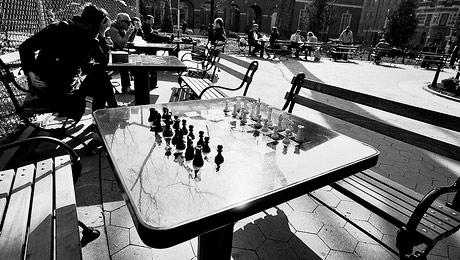
Our thoughts can be like a chess game, a constant battle between two sides. We could also choose not to always play those pieces and be the chessboard instead.
I set out the chess board. I filled a pipe, paraded the chessmen and inspected them for French shaves and loose buttons, and played a championship tournament game between Gortchakoff and Meninkin, seventy-two moves to a draw, a prize specimen of the irresistible force meeting the immovable object, a battle without armor, a war without blood, and as elaborate a waste of human intelligence as you could find anywhere outside an advertising agency.”
The Chessboard Metaphor, a central ACT intervention, connects the client to the distinction between content and the observing self:
Imagine a chessboard that goes out infinitely in all directions. It’s covered with black pieces and white pieces. They work together in teams, as in chess—the white pieces fight against the black pieces. You can think of your thoughts and feelings and beliefs as these pieces; they sort of hang out together in teams too. For example, “bad” feelings (like anxiety, depression, resentment) hang out with “bad” thoughts and “bad” memories. Same thing with the “good” ones. So it seems that the way the game is played is that we select the side we want to win. We put the “good” pieces (like thoughts that are self-confident, feelings of being in control, etc.) on one side, and the “bad” pieces on the other. Then we get up on the back of the black horse and ride to battle, fighting to win the war against anxiety, depression, thoughts about using drugs, whatever. It’s a war game. But there’s a logical problem here, and that is that from this posture huge portions of yourself are your own enemy. In other words, if you need to be in this war, there is something wrong with you. And because it appears that you’re on the same level as these pieces, they can be as big or even bigger than you are—even though these pieces are in you. So somehow, even though it is not logical, the more you fight the bigger they get. If it is true that “if you are not willing to have it, you’ve got it,” then as you fight these pieces they become more central to your life, more habitual, more dominating, and more linked to every area of living. The logical idea is that you will knock enough of them off the board that you eventually dominate them—except that your experience tells you that the exact opposite happens. Apparently, the white pieces can’t be deliberately knocked off the board. So the battle goes on. You feel hopeless, you have a sense that you can’t win, and yet you can’t stop fighting. If you’re on the back of that black horse, fighting is the only choice you have, because the white pieces seem life threatening. Yet living in a war zone is no way to live.
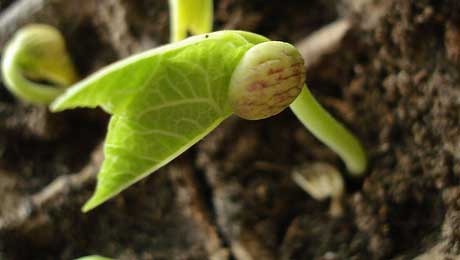
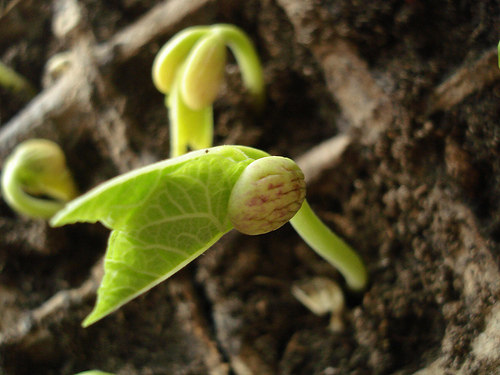
The soil above the seed is hard to push through, but this very handicap, this resistance to the soil, forces the young sprout to gather strength for the battle. Where shall it get this additional strength? Instead of fighting ineffectively against the topsoil, the seed sends out delicate roots to gather more nourishment. Thus the sprout at last penetrates the hard soil and wins through to the sun. According to science, a single thistle needs ten thousand inches of root to support a thirty- or forty-inch stem. You can guess how many thousands of facts a dramatist must unearth to support a single character. By way of parable, let a man represent the soil; in his mind we shall plant a seed of coming conflict: ambition, perhaps. The seed grows in him, though he may wish to squelch it. But forces within and without the man exert greater and greater pressure, until this seed of conflict is strong enough to burst through his stubborn head. He has made a decision, and now he will act upon it. The contradictions within a man and the contradictions around him create a decision and a conflict. These in turn force him into a new decision and a new conflict.”













 thefictiontherapist.com