Despite his reputation as a rogue, Ernest Hemingway advocated mindful techniques for writing and for living, and he offers good advice on how to be considerate to others.
When people talk listen completely. Donʼt be thinking what youʼre going to say. Most people never listen. Nor do they observe. You should be able to go into a room and when you come out know everything that you saw there and not only that. If that room gave you any feeling you should know exactly what it was that gave you that feeling. Try that for practice. When youʼre in town stand outside the theatre and see how people differ in the way they get out of taxis or motor cars. There are a thousand ways to practice. And always think of other people.’
‘With mindful attention, we bring a nonjudging, open attitude to our experience. We also refer to this way of relating to feelings and thoughts as acceptance, defined as opening to up and allowing your experience to be exactly as it is, without trying to avoid it, escape it or change it.’
Jan E. Fleming and Nancy L. Kocovski. The Mindfulness and Acceptance Workbook for Social Anxiety and Shyness – Using Acceptance and Commitment Therapy to Free Yourself from Fear and Reclaim Your Life.
Our conscious views of what life ought to be seldom correspond to what life really is. Generally we refuse to admit within ourselves, or within our friends, the fullness of that pushing, self-protective, malodorous, carnivorous, lecherous fever which is the very nature of the organic cell. Rather, we tend to perfume, whitewash, and reinterpret; meanwhile imagining that all the flies in the ointment, all the hairs in the soup, are the faults of some unpleasant someone else.’
Joseph Campbell. The Hero with a Thousand Faces
‘Blame is usually about making the other person wrong. Is this really useful to or working for you? While blame can be very effective and appropriate in a court of law, it most often brings unnecessary suffering to the realm of interpersonal relationships. In fact, there is a saying that holding onto resentment is like drinking poison and hoping the other person will die.’
Victoria M. Follette and Jacqueline Pistorello. Finding Life beyond Trauma: Using Acceptance and Commitment Therapy to Heal From Post-Traumatic Stress and Trauma-Related Problems.
* In a series of posts I call mythology Monday, I look at quotes from the work of mythologist Joseph Campbell and consider them alongside extracts from books and papers on acceptance and commitment therapy (ACT) and related publications.
Sometimes we invent stories, often brilliant stories, to avoid something in our lives. To get on with what you should be doing, it helps to see these excuses for what they are, just stories.
One of my favorite forms of resistance is sitting down to write and suddenly getting an idea for another screenplay—a much better idea, an idea so unique, so original, so exciting, you wonder what you’re doing writing this screenplay. You really think about it. You may even get two or three “better” ideas. It happens quite often; it may be a great idea, but it’s still a form of resistance! If it’s really a good idea, it will keep. Simply write it up in a page or two, put it in a file marked “New Projects,” and file it away. If you decide to pursue this new idea and abandon the original project, you’ll discover the same thing happening; When you sit down to write, you’ll get another new idea, and so on and so on. It’s a form of resistance; a mind trip, a way of avoiding writing. We all do it. We’re masters at creating reasons and excuses not to write; it’s simply a barrier to the creative process. So, how do you deal with it? Simple. If you know it’s going to happen, simply acknowledge it when it does. When you’re cleaning the refrigerator, sharpening pencils, or eating, just know that’s what you’re doing: experiencing resistance! It’s no big thing. Don’t put yourself down, feel guilty, feel worthless, or punish yourself in any way. Just acknowledge the resistance—then move right through to the other side. Just don’t pretend it’s not happening. It is! Once you deal with your resistance, you’re ready to start writing.
Syd Field. Screenplay: The Foundations of Screenwriting.
‘Since childhood you’ve heard, ‘Don’t believe everything you read.’ When we read about celebrities in the tabloids, we know that many of the stories are false or misleading. Some are exaggerated for effect, others are made up entirely. Now some celebrities take this in their stride; they accept it as part of being famous and don’t let it get to them. When they notice ridiculous stories about themselves, they just shrug it off. They certainly don’t waste their time reading, analysing and discussing them! Other celebrities, though, get very upset about these stories. They read them and dwell on them, rant and complain, and lodge lawsuits (which are stressful and eat up a lot of time, energy and money).
‘Defusion allows us to be like the first set of celebrities: the stories are there, but we don’t take them seriously. We don’t pay them much attention, and we certainly don’t waste our time and energy trying to fight them. In ACT we don’t try to change, avoid or get rid of the story. We know how ineffective that is. Instead we simply acknowledge: ‘This is a story.’
Russ Harris. The Happiness Trap: How to Stop Struggling, Start Living
Wars and temper tantrums are the makeshifts of ignorance; regrets are illuminations come too late. The whole sense of the ubiquitous myth of the hero’s passage is that it shall serve as a general pattern for men and women, wherever they may stand along the scale. Therefore it is formulated in the broadest terms. The individual has only to discover his own position with reference to this general human formula, and let it then assist him past his restricting walls. Who and where are his ogres”? Those are the reflections of the unsolved enigmas of his own humanity. What are his ideals’? Those are the symptoms of his grasp of life.
Joseph Campbell. The Hero with a Thousand Faces
If you were on a bus trying to go east in a maze of dirt roads in a large valley, you might not be able to tell your direction from moment to moment. If someone took a series of snapshots, sometimes the bus might be facing north, or south, or even west, even though all the while this is a journey to the east.
Paths are not straight because obstacles sometimes prevent movement in the desired direction. A person who values creating a loving family may nevertheless have to go through a divorce. In that situation, the intention to be loving may be revealed only in limited ways, such as not establishing oppositions between yourself and your spouse that will negatively affect your children, or treating a soon-to-be ex-spouse fairly in the division of assets. Only over time will the underlying value become evident, like tracks left in the snow that show, even though the path is not straight, it is headed east.
Paths are also not straight because we are human. We may intend to go east, but our attention may wander, and we may find ourselves heading north. Someone in recovery from a drug addiction who values sobriety and helping others may still relapse. That person’s mind may be screaming, “See, you can’t go east! You are a liar and a failure! You can’t be trusted!” as if to say, “Because you are heading north, as usual, you cannot value heading east.” In such an instance, that person’s task will be to thank his or her mind, feel the sadness and pain that comes from relapse, and then turn and head east once again.
Steven Hayes & Spencer Smith. Get out of your mind and into your life: the new acceptance and commitment therapy.
* In a series of posts I call mythology Monday, I look at quotes from the work of mythologist Joseph Campbell and consider them alongside extracts from books and papers on acceptance and commitment therapy (ACT) and related publications.
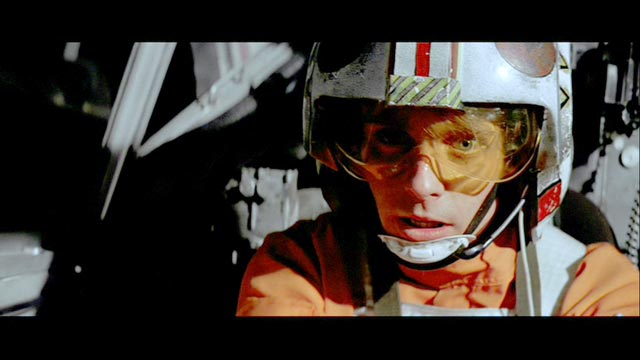
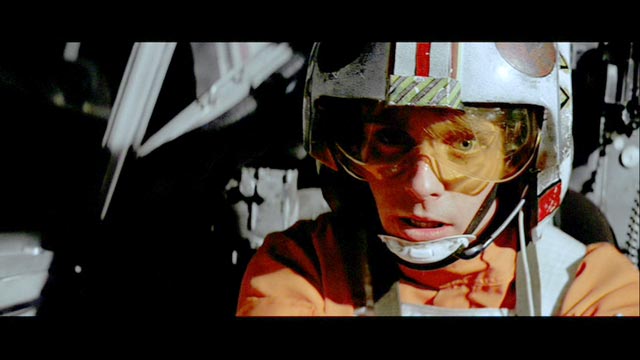
Language, like the Force in Star Wars, has a dark side. We have to learn to use it to our advantage, rather than let it use us.
Luke Skywalker attacks the “Death Star,” a manmade fortress as huge as a planet. But it’s not fully constructed. A vulnerable slot lies open on one side of the sphere. Luke must not only attack into the slot, but hit a vulnerable spot within it. He’s an expert fighter pilot but tries without success to hit the spot. As he maneuvers his craft by computer, he hears the voice of Obi-Wan Kenobi: “Go with the Force, go with the Force.”
‘A sudden dilemma of irreconcilable goods: the computer versus the mysterious “Force.” He wrestles with the anguish of choice, then pushes his computer aside, flies by instinct into the slot, and fires a torpedo that hits the spot. The destruction of the Death Star climaxes the film, a straight action out of the Crisis.’
Robert McKee. Story: Substance, Structure, Style, and the Principles of Screenwriting
‘We cannot appreciate the human dilemma if we do not see the nature and speed of human progress clearly. Human misery can be understood only in the context of human achievement, because the most important source of each is the same: human symbolic activity. To borrow a phrase from the Star Wars trilogy, language is truly “The Force” in human progress. It is so enormously influential in human affairs because it has such a bright side.
‘But The Force has a dark side too. Psychotherapists know that side well. This dual nature of human language impacts not just at the level of the group—the human species or human civilization—but also at the level of the individual. Each individual has experienced both the bright and the dark side of The Force. To ask an individual human being to challenge the nature and role of language in his or her own behavior is tantamount to asking a carpenter to question the general utility of a hammer. But hammers are not good for everything, and language is not good for everything either. We must learn to use language without being consumed by it. We must learn to manage it rather than having it manage us. We must learn to overcome the dark side.’
Steven C. Hayes, Kirk D. Strosahl & Kelly G. Wilson. Acceptance and Commitment Therapy: An Experiential Approach to Behavior Change.
It’s easy to get an idea for writing, said playwright Lajos Egri. Find inspiration by taking a quiet moment to observe the world around you and within you.
To get an idea for any type of writing is the easiest thing. Look around you and be observant. Be observant and you will be forced to admit that the world is an inexhaustible pastry shop and you are permitted to choose from the delicacies the tastiest bits for yourself.
Lajos Egri. The Art of Dramatic Writing
‘The capacity to observe change is severely limited by the fact that much of our time is spent in incessant activity that does not provide a stable reference point. Encouraging “just sitting” is a simple way of quieting the body long enough so that that one’s focus can shift to other objects of consciousness, including the mind. Moving around and doing things requires a certain amount of cognitive processing capacity that tends to narrow the scope of attention to instrumental concerns. Sitting quietly, on the other hand, produces an interesting and somewhat paradoxical state of relaxed awareness, which in turn reduces cognitive demands and frees the resultant capacity for other purposes.
‘Quiet, relaxed awareness provides an ideal vantage point from which to observe change processes that are otherwise typically obscured. Manifestations are everywhere. Observation of the breath reveals phasic change from breathing in to breathing out. Observation of inner states reveals both regular and intermittent interoceptive sensations signifying a myriad of changes in underlying physiological processes. Observation of sights and sounds reveals a constant but often subtle flow of energy states captured by sense organs that are themselves constantly changing.’
Paul G. Salmon, Sandra E. Sephton, and Samuel J. Dreeben. Mindfulness-Based Stress Reduction. In Mindfulness in Cognitive Behavior Therapy: Understanding and Applying the New Therapies.
There can be no question: the psychological dangers through which earlier generations were guided by the symbols and spiritual exercises of their mythological and religious inheritance, we today (in so far as we are unbelievers, or, if believers, in so far as our inherited beliefs fail to represent the real problems of contemporary life) must face alone, or, at best, with only tentative, impromptu, and not often very effective guidance. This is our problem as modern, “enlightened” individuals, for whom all gods and devils have been rationalized out of existence. Nevertheless, in the multitude of myths and legends that have been preserved to us, or collected from the ends of the earth, we may yet see delineated something of our still human course. To hear and profit, however, one may have to submit somehow to purgation and surrender. And that is part of our problem: just how to do that. “Or do ye think that ye shall enter the Garden of Bliss without such trials as came to those who passed away before you?”
Joseph Campbell. The Hero with a Thousand Faces
When we encounter painful content within ourselves, we want to do what we always do: fix it up and sort it out so that we can get rid of it. The truth of the matter (as you have likely experienced) is that our internal lives are not at all like external events. For one thing, humans live in history, and time moves in only one direction, not two. Psychological pain has a history and, at least in that aspect, it is not a matter of getting rid of it. It is more a matter of how we deal with it and move forward.
The “acceptance” in Acceptance and Commitment Therapy is based on the notion that, as a rule, trying to get rid of your pain only amplifies it, entangles you further in it, and transforms it into something traumatic. Meanwhile, living your life is pushed to the side. The alternative we will teach in this book is a bit dangerous to say out loud because right now it is likely to be misunderstood, but the alternative is to accept it. Acceptance, in the sense it is used here, is not nihilistic self-defeat; neither is it tolerating and putting up with your pain. It is very, very different than that. Those heavy, sad, dark forms of “acceptance” are almost the exact opposite of the active, vital embrace of the moment that we mean.
Steven Hayes & Spencer Smith. Get out of your mind and into your life: the new acceptance and commitment therapy.
* In a series of posts I call mythology Monday, I look at quotes from the work of mythologist Joseph Campbell and consider them alongside extracts from books and papers on acceptance and commitment therapy (ACT) and related publications.
When confronted with the unknown, you don’t have to continue with your old way of life. Take the bold step, like a mythological hero, and cross the threshold into a new way of living.
The adventure is always and everywhere a passage beyond the veil of the known into the unknown; the powers that watch at the boundary are dangerous; to deal with them is risky; yet for anyone with competence and courage the danger fades.
Joseph Campbell. The Hero with a Thousand Faces.
Life is asking you a question. The question was once mumbled, misunderstood, or nearly inaudible. It’s not surprising that you haven’t answered yes, but, unfortunately, failing to answer or answering no have nearly the same results, and they have those results whether you know that you are being asked a question or not.
It’s time to begin to jump. Answering yes to the life question, no matter how narrowly it’s cast, is such a jump. It is a jump into the unknown. It is a jump into a world in which getting rid of or managing your own history is no longer required in order to begin to live the life you truly want to live. It is a world of self-acceptance, openness, ambiguity of content, and clarity of purpose. It is a world of psychological flexibility, in which you let go of the struggle, give up and live, less concerned about being right than being alive.
You do not have to say yes. Life will accept either answer. There is, however, a cost to silence or to saying no. Indeed, you’ve been experiencing those costs. Your pain is your biggest ally here. Have you suffered enough? Have you?
We don’t want to scare you. You don’t have to begin by jumping from the Empire State Building. You can jump off a sheet of paper, or a thin paperback book. But if you are going to start, you must start.
Steven C. Hayes and Spencer Smith. Get out of your mind and into your life: the new acceptance and commitment therapy.
* In a series of posts I call mythology Monday, I look at quotes from the work of mythologist Joseph Campbell and consider them alongside extracts from books and papers on acceptance and commitment therapy (ACT) and related publications.
When we get to know someone very well, we also see their imperfections. For a healthy relationship, it’s important not to dwell on those negative thoughts.
‘I feel like Amy wanted people to believe she really was perfect. And as we got to be friends, I got to know her. And she wasn’t perfect. You know? She was brilliant and charming and all that, but she was also controlling and OCD and a drama queen and a bit of a liar. Which was fine by me. It just wasn’t fine by her. She got rid of me because I knew she wasn’t perfect…Friends see most of each other’s flaws. Spouses see every awful last bit.’
Gillian Flynn. Gone Girl.
‘Truth is, there’s no such thing as the perfect partner, just as there’s no such thing as the perfect couple. (As the old joke goes, there are only two types of couples: those who have a wonderful relationship, and ACT with love 10 those whom you know really well.) But how hard is it to truly let go of this idea? How hard is it to stop comparing your partner to others? To stop fantasizing about the partner you could have had, or would have had, or should have had? Or about the partner you really did have, but for one reason or another it didn’t last? How hard is it to stop dwelling on your partner’s faults and flaws and shortcomings, and thinking about how life would be so much better if only your partner would change?
‘Answer: very hard indeed, for most normal human beings. But it doesn’t have to remain that way. Change is possible, if you want it. Let’s just take a moment to look at what it is costing you to get all caught up in these patterns of thinking. How much frustration, anger, and disappointment does it create for you? Of course, I’m not advocating that you let your partner do as she pleases, whenever she wants, without any consideration for you; that would not give rise to a healthy, vital relationship. What I am advocating is that you take an honest look at your own internalized beliefs about how your partner should behave and what your relationship should be like; notice all the negative judgments you make about your partner and your relationship; and notice how these thoughts affect you when you get caught up in them. Are they helping your relationship or harming it?’















 thefictiontherapist.com