When it’s on target, a simile delights us in much the same way meeting an old friend in a crowd of strangers does. By comparing two seemingly unrelated objects—a restaurant bar and a cave, a mirror and a mirage—we are sometimes able to see an old thing in a new and vivid way. Even if the result is mere clarity instead of beauty, I think writer and reader are participating together in a kind of miracle. Maybe that’s drawing it a little strong, but yeah—it’s what I believe.’
‘Metaphors are not simply logical, linear forms of verbal behavior: they are more like pictures. The point of the ACT metaphors is often hard to capture in a simple moral or verbal conclusion. Instead, metaphors present a picture of how things work in a given domain. Carefully presented metaphors can be a kind of experiential exercise—as if one had actually experienced the described event or story. The event is verbal, and thus the experiences are derived and not direct, but the impact of the talk is still more experiential because the talk used is not linear, analytic, or proscriptive. This is advantageous inasmuch as ACT is attempting to ground client action in the direct experience of contingencies and in rules that track those contingencies. Metaphors help set a social/verbal context in which overreliance on rationality is questioned and where the wisdom of directly experienced contingencies is more highly valued.’
You don’t have to let your thoughts lead the way. Find out what’s important to you, what truly matters to you, and let those values guide your actions.
Tom Dunson, played by John Wayne in the classic Western Red River, makes a terrible moral error early in his career as a cattleman, by choosing to value his mission more than his love, and following his head rather than his heart. This choice leads to the death of his lover, and for the rest of the story he bears the psychic scars of that wound. His suppressed guilt makes him more and more harsh, autocratic, and judgmental, and almost brings him and his adopted son to destruction before the wound is healed by letting love back into his life.
A hero’s wounds may not be visible. People put a great deal of energy into protecting and hiding these weak and vulnerable spots. But in a fully developed character they will be apparent in the areas where she is touchy, defensive, or a little too confident. The wound may never be openly expressed to the audience — it can be a secret between the writer and the character. But it will help give the hero a sense of personal history and realism, for we all bear some scars from past humiliations, rejections, disappointments, abandonments, and failures. Many stories are about the journey to heal a wound and to restore a missing piece to a broken psyche.
Often we know full well when we’re making excuses—we just need to be honest with ourselves. But if you’ve set a valued goal, and your mind gives you a reason not to attempt it, sometimes it’s not so clear that this is just an excuse. So if you’re genuinely unsure whether the thought is merely an excuse for inaction, or a statement of fact about something that truly is impossible, just ask yourself this question: ‘If the person you care about more than anyone else in the world were kidnapped, and the kidnappers told you they will never release that person until you take a particular action toward your goals, would you then take action?’ If the answer is yes, then you know that any reason (for not taking that action) is merely an excuse.
‘Ah, yes,’ you may be saying, ‘but that’s just a silly hypothetical question. In the real world, the person I love has not been kidnapped.’
Right you are. But what’s at stake in the real world is something equally important: your life! Do you want to live a life in which you do the things that are really meaningful to you? Or do you want to live a life of drifting aimlessly, letting your demons run the ship?
‘Okay,’ I hear you say. ‘I agree that I could attempt this goal, but it’s not that important to me.’
The question here is, are you being honest with yourself? Or are you just buying into another thought? If the goal you’re avoiding is truly unimportant to you, fine, don’t attempt it. But make sure you check in with your values. And if this goal really is something you value, then you are faced with a choice: either act in accordance with what you value, or let yourself be pushed around by your own thoughts.
To create great characters, writers need to understand their own thoughts and feelings first.
We all share the same crucial human experiences. Each of us is suffering and enjoying, dreaming and hoping of getting through our days with something of value. As a writer, you can be certain that everyone coming down the street toward you, each in his own way, is having the same fundamental human thoughts and feelings that you are. This is why when you ask yourself, “If I were this character in these circumstances, what would I do?” The honest answer is always correct. You would do the human thing. Therefore, the more you penetrate the mysteries of your own humanity, the more you come to understand yourself, the more you are able to understand others.
Often many people we meet in our daily lives seem to have it all. They seem happy. They look satisfied with their lives. You’ve probably had the experience of walking down the street when you’re having a particularly bad day, and you’ve looked around and thought, “Why can’t I just be happy like everyone around me? They don’t suffer from chronic panic (or depression, or a substance abuse problem). They don’t feel as if a dark cloud is always looming over their heads. They don’t suffer the way I suffer. Why can’t I be like them?”
Here’s the secret: They do and you are. We all have pain. All human beings, if they live long enough, have felt or will feel the devastation of losing someone they love. Every single person has felt or will feel physical pain. Everybody has felt sadness, shame, anxiety, fear, and loss. We all have memories that are embarrassing, humiliating, or shameful. We all carry painful hidden secrets. We tend to put on shiny, happy faces, pretending that everything is okay, and that life is “all good.” But it isn’t and it can’t be. To be human is to feel pain in ways that are orders of magnitude more pervasive than what the other creatures on planet Earth feel.
Find inspiration to write a truly great story by examining the things that matter most to you.
Write Something That May Change Your Life
First, write down your wish list, a list of everything you would like to see up on the screen, in a book, or at the theater. It’s what you are passionately interested in, and it’s what entertains you. You might jot down characters you have imagined, cool plot twists, or great lines of dialogue that have popped into your head. You might list themes that you care about or certain genres that always attract you.
Write them all down on as many sheets of paper as you need. This is your own personal wish list, so don’t reject anything. Banish thoughts like “That would cost too much money.” And don’t organize while you write. Let one idea trigger another.
The second exercise is to write a premise list. This is a list of every premise you’ve ever thought of. That might be five, twenty, fifty, or more. Again, take as many sheets of paper as you need. The key requirement of the exercise is that you express each premise in one sentence. This forces you to be very clear about each idea. And it allows you to see all your premises together in one place.
Once you have completed both your wish list and your premise list, lay them out before you and study them.
As you study, key patterns will start to emerge about what you love. This, in the rawest form possible, is your vision. It’s who you are, as a writer and as a human being, on paper in front of you. Go back to it often.
Notice that these two exercises are designed to open you up and to integrate what is already deep within you. They won’t guarantee that you write a story that changes your life. Nothing can do that. But once you’ve done this essential bit of self-exploration, any premise you come up with is likely to be more personal and original.
In ACT, the values assessment process serves a variety of assessment and intervention purposes. First, the client may become aware of long suppressed values. This process is motivational in the sense that the client may find major discrepancies between valued versus current behaviors. Second, the process of values assessment can help highlight a place in the client’s life in which everything is absolutely perfect and pristine.
A writer has to learn to feel the present moment in order to reproduce the sounds, actions and emotions for the reader.
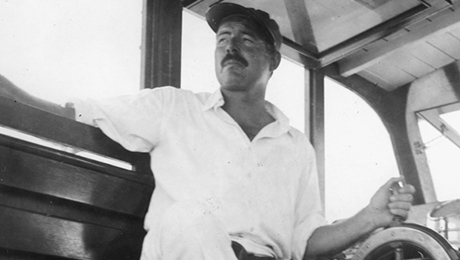
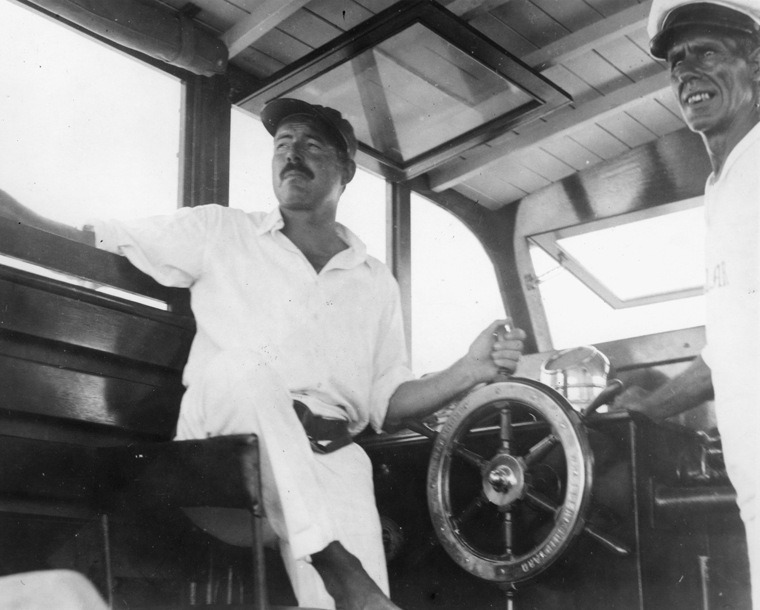
Hemingway on his boat, the Pilar
Watch what happens today. If we get into a fish see exactly what it is that everyone does. If you get a kick out of it while he is jumping remember back until you see exactly what the action was that gave you that emotion. Whether it was the rising of the line from the water and the way it tightened like a fiddle string until drops started from it, or the way he smashed and threw water when he jumped. Remember what the noises were and what was said. Find what gave you the emotion, what the action was that gave you the excitement. Then write it down making it clear so the reader will see it too and have the same feeling you had.’
‘To allow ourselves to be truly in touch with where we already are, no matter where that is, we have got to pause in our experience long enough to let the present moment sink in; long enough to actually feel the present moment, to see it in its fullness, to hold it in awareness and thereby come to know and understand it better. Only then can we accept the truth of this moment of our life, learn from it, and move on.’





 .
.


 Write them all down on as many sheets of paper as you need. This is your own personal wish list, so don’t reject anything. Banish thoughts like “That would cost too much money.” And don’t organize while you write. Let one idea trigger another.

 thefictiontherapist.com