There can be no question: the psychological dangers through which earlier generations were guided by the symbols and spiritual exercises of their mythological and religious inheritance, we today (in so far as we are unbelievers, or, if believers, in so far as our inherited beliefs fail to represent the real problems of contemporary life) must face alone, or, at best, with only tentative, impromptu, and not often very effective guidance. This is our problem as modern, “enlightened” individuals, for whom all gods and devils have been rationalized out of existence. Nevertheless, in the multitude of myths and legends that have been preserved to us, or collected from the ends of the earth, we may yet see delineated something of our still human course. To hear and profit, however, one may have to submit somehow to purgation and surrender. And that is part of our problem: just how to do that. “Or do ye think that ye shall enter the Garden of Bliss without such trials as came to those who passed away before you?”
Joseph Campbell. The Hero with a Thousand Faces
When we encounter painful content within ourselves, we want to do what we always do: fix it up and sort it out so that we can get rid of it. The truth of the matter (as you have likely experienced) is that our internal lives are not at all like external events. For one thing, humans live in history, and time moves in only one direction, not two. Psychological pain has a history and, at least in that aspect, it is not a matter of getting rid of it. It is more a matter of how we deal with it and move forward.
The “acceptance” in Acceptance and Commitment Therapy is based on the notion that, as a rule, trying to get rid of your pain only amplifies it, entangles you further in it, and transforms it into something traumatic. Meanwhile, living your life is pushed to the side. The alternative we will teach in this book is a bit dangerous to say out loud because right now it is likely to be misunderstood, but the alternative is to accept it. Acceptance, in the sense it is used here, is not nihilistic self-defeat; neither is it tolerating and putting up with your pain. It is very, very different than that. Those heavy, sad, dark forms of “acceptance” are almost the exact opposite of the active, vital embrace of the moment that we mean.
Steven Hayes & Spencer Smith. Get out of your mind and into your life: the new acceptance and commitment therapy.
* In a series of posts I call mythology Monday, I look at quotes from the work of mythologist Joseph Campbell and consider them alongside extracts from books and papers on acceptance and commitment therapy (ACT) and related publications.
When confronted with the unknown, you don’t have to continue with your old way of life. Take the bold step, like a mythological hero, and cross the threshold into a new way of living.
The adventure is always and everywhere a passage beyond the veil of the known into the unknown; the powers that watch at the boundary are dangerous; to deal with them is risky; yet for anyone with competence and courage the danger fades.
Joseph Campbell. The Hero with a Thousand Faces.
Life is asking you a question. The question was once mumbled, misunderstood, or nearly inaudible. It’s not surprising that you haven’t answered yes, but, unfortunately, failing to answer or answering no have nearly the same results, and they have those results whether you know that you are being asked a question or not.
It’s time to begin to jump. Answering yes to the life question, no matter how narrowly it’s cast, is such a jump. It is a jump into the unknown. It is a jump into a world in which getting rid of or managing your own history is no longer required in order to begin to live the life you truly want to live. It is a world of self-acceptance, openness, ambiguity of content, and clarity of purpose. It is a world of psychological flexibility, in which you let go of the struggle, give up and live, less concerned about being right than being alive.
You do not have to say yes. Life will accept either answer. There is, however, a cost to silence or to saying no. Indeed, you’ve been experiencing those costs. Your pain is your biggest ally here. Have you suffered enough? Have you?
We don’t want to scare you. You don’t have to begin by jumping from the Empire State Building. You can jump off a sheet of paper, or a thin paperback book. But if you are going to start, you must start.
Steven C. Hayes and Spencer Smith. Get out of your mind and into your life: the new acceptance and commitment therapy.
* In a series of posts I call mythology Monday, I look at quotes from the work of mythologist Joseph Campbell and consider them alongside extracts from books and papers on acceptance and commitment therapy (ACT) and related publications.
When we get to know someone very well, we also see their imperfections. For a healthy relationship, it’s important not to dwell on those negative thoughts.
‘I feel like Amy wanted people to believe she really was perfect. And as we got to be friends, I got to know her. And she wasn’t perfect. You know? She was brilliant and charming and all that, but she was also controlling and OCD and a drama queen and a bit of a liar. Which was fine by me. It just wasn’t fine by her. She got rid of me because I knew she wasn’t perfect…Friends see most of each other’s flaws. Spouses see every awful last bit.’
Gillian Flynn. Gone Girl.
‘Truth is, there’s no such thing as the perfect partner, just as there’s no such thing as the perfect couple. (As the old joke goes, there are only two types of couples: those who have a wonderful relationship, and ACT with love 10 those whom you know really well.) But how hard is it to truly let go of this idea? How hard is it to stop comparing your partner to others? To stop fantasizing about the partner you could have had, or would have had, or should have had? Or about the partner you really did have, but for one reason or another it didn’t last? How hard is it to stop dwelling on your partner’s faults and flaws and shortcomings, and thinking about how life would be so much better if only your partner would change?
‘Answer: very hard indeed, for most normal human beings. But it doesn’t have to remain that way. Change is possible, if you want it. Let’s just take a moment to look at what it is costing you to get all caught up in these patterns of thinking. How much frustration, anger, and disappointment does it create for you? Of course, I’m not advocating that you let your partner do as she pleases, whenever she wants, without any consideration for you; that would not give rise to a healthy, vital relationship. What I am advocating is that you take an honest look at your own internalized beliefs about how your partner should behave and what your relationship should be like; notice all the negative judgments you make about your partner and your relationship; and notice how these thoughts affect you when you get caught up in them. Are they helping your relationship or harming it?’
When you take responsibility – the ability to respond – you can stop blaming others and finally become the creative, innovative person you have always been.
If the first requirement of an adult is that he should take to himself responsibility for his failures, for his life, and for his doing, within the context of the actual conditions of the world in which he dwells, then it is simply an elementary psychological fact that no one will ever develop to this state who is continually thinking of what a great thing he would have been had only the conditions of his life been different: his parents less indifferent to his needs, society less oppressive, or the universe otherwise arranged. The first requirement of any society is that its adult membership should realize and represent the fact that it is they who constitute its life and being. And the first function of the rites of puberty, accordingly, must be to establish in the individual a system of sentiments that will be appropriate to the society in which he is to live, and on which that society itself must depend for its existence.
In the modern Western world, moreover, there is an additional complication; for we ask of the adult something still more than that he should accept without personal criticism and judgment the habits and inherited customs of his local social group. We ask and we are expecting, rather, that he should develop what Sigmund Freud has called his “reality function”: that faculty of the independently observant, freely thinking individual who can evaluate without preconceptions the possibilities of his environment and of himself within it, criticizing and creating, not simply reproducing inherited patterns of thought and action, but becoming himself an innovating center, an active, creative center of the life process.
Joseph Campbell. Myths to Live By (The Collected Works of Joseph Campbell).
In [one example, a] person realized over time that having or not having a job was his response-ability#, even though his father had hit him and then abandoned the family. This man explained that deep inside he had struggled with whether or not he was to blame for hanging in there for so long and not standing up to his father. He had put all this adult responsibility on the child he was then. Staying stuck in this cycle of blame was interfering with his ability to be effective now. The discussion on focusing on response-ability instead of blame allowed him to feel more empowered to take control of his life. It became an issue of letting go of being right so that he could build a stable life for his family, something he valued.
Who would you be now if you could let go of the struggle with judgment, blame, being right (or wrong), and all the other passengers on your bus? What if you begin to have compassion and acceptance for yourself? For many trauma survivors, the first step in this direction is to begin to identify a sense of self—the you who has always been present.
Victoria M. Follette and Jacqueline Pistorello. Finding life beyond trauma: using acceptance and commitment therapy to heal from post-traumatic stress and trauma-related problems.
# The root of the word responsibility is actually “response-ability” or the ability to respond (Hayes, Strosahl, and Wilson 1999). This ability is something that can empower people to take control over their lives.
* In a series of posts I call mythology Monday, I look at quotes from the work of mythologist Joseph Campbell and consider them alongside extracts from books and papers on acceptance and commitment therapy (ACT) and related publications.
Evolution has taught us to solve problems by fight or flight. It’s natural then that we apply the same tactics to our psychological problems, but it’s a strategy that doesn’t always work.
I listened intently and heard a sound. It was Tina. Or not really Tina. The gleaming eyes of the wolf stared back at me from the darkest corner of the storeroom. God help me, I didn’t know what to do. If we’d been in the village, I would have jumped on the horse, ridden straight to Kazem Khan’s and cried, “Come quick! The wolf is back!”
But we weren’t in the village and Kazem Khan wasn’t here.
So I took a step backwards, as I had seen Kazem Khan do, and called softly to my sister, “Go and get the Holy Book!” She snatched the book off the mantel and handed it to me.
I knelt by the storeroom door, turned to the wild beast, kissed the cover, closed my eyes, opened the book to a page and began to chant.
As I recited the sura, I quietly took one step forward, then another. Reciting all the while, I held out my hand to her and saw the light go out in the wolf’s eyes. I went on until I felt Tina’s hand seek mine in the darkness. “Come, Tina, come!” I whispered. “Let’s go eat.” She struggled to her feet and then walked into the living room.
I look out my window and I see the wolf running through the Dutch polder.
Let it run, let it go, let the wolf lose its way on this new ground, so it will never be able to find its way back to Tina.’
Kader Abdollah. My Father’s Notebook. Translated from Dutch by Susan Massotty.
‘Probably the single biggest evolutionary advantage of human language was the ability to anticipate and solve problems. This has enabled us not only to change the face of the planet, but to travel outside it. The essence of problem-solving is this:
Problem = something we don’t want.
Solution = figure out how to get rid of it, or avoid it.
This approach obviously works well in the material world. A wolf outside your door? Get rid of it. Throw rocks at it, or spears, or shoot it. Snow, rain, hail? Well, you can’t get rid of those things, but you can avoid them, by hiding in a cave, or building a shelter. Dry, arid ground? You can get rid of it, by irrigation and fertilisation, or you can avoid it, by moving to a better location. Problem solving strategies are therefore highly adaptive for us as humans (and indeed, teaching such skills has proven to be effective in the treatment of depression). Given this problem solving approach works well in the outside world, it’s only natural that we would tend to apply it to our interior world; the psychological world of thoughts, feelings, memories, sensations, and urges. Unfortunately, all too often when we try to avoid or get rid of unwanted private experiences, we simply create extra suffering for ourselves. For example, virtually every addiction known to mankind begins as an attempt to avoid or get rid of unwanted thoughts and feelings, such as boredom, loneliness, anxiety, depression and so on. The addictive behaviour then becomes selfsustaining, because it provides a quick and easy way to get rid of cravings or withdrawal symptoms.
Russell Harris. Embracing Your Demons: an Overview of Acceptance and Commitment Therapy
The myths and folk tales of the whole world make clear that the refusal is essentially a refusal to give up what one takes to be one’s own interest. The future is regarded not in terms of an unremitting scries of deaths and births, but as though one’s present system of ideals, virtues, goals, and advantages were to be fixed and made secure. King Minos retained the divine bull, when the sacrifice would have signified submission to the will of the god of his society; for he preferred what he conceived to be his economic advantage. Thus he failed to advance into the liferole that he had assumed—and we have seen with what calamitous effect. The divinity itself became his terror; for, obviously, if one is oneself one’s god, then God himself, the will of God, the power that would destroy one’s egocentric system, becomes a monster.
One is harassed, both day and night, by the divine being that is the image of the living self within the locked labyrinth of one’s own disoriented psyche. The ways to the gates have all been lost: there is no exit. One can only cling, like Satan, furiously, to oneself and be in hell; or else break, and be annihilate at last, in God.
Joseph Campbell. The Hero with a Thousand Faces.
The Buddhist tradition describes three poisons of the mind—greed, aversion, and ignorance. We developed this task for Zen students who seem particularly afflicted by aversion, those who habitually resist anything asked of them and what comes forward in life. Their initial and unconscious response to anything asked of them is “no,” expressed either in body language or out loud. Sometimes the no is expressed as “yes, but . . . ,” and sometimes it is cloaked in reasonable language, but it is still a consistent and persistent pattern of opposition.
People who are stuck in aversion often make major life decisions based not upon moving toward a positive goal but rather upon moving away from something they perceive to be negative. They are reactive rather than proactive. “My parents didn’t pay their bills on time and our electricity got turned off. I’m going to become an accountant,” instead of “I want to become an accountant because I love numbers.”
When monks enter training at Japanese Soto Zen monasteries, they are told that the only acceptable response to anything they are asked to do in the first year of training is, “Hai! (Yes!).” This is powerful training. It cuts through layers of apparent maturity, down to the defiant two-year-old and/or teenager within.
Not expressing opposition helps us to let go of self-centered views and see that our personal opinion is actually not so important after all. It’s surprising how often our disagreement with another person is actually unimportant and only serves to increase our distress and the suffering of those around us. Saying yes can be energizing, since habitual resistance is a persistent drain on our life energy.
Final words: Cultivate an internal attitude of “yes” to life and all it brings you. It will save you lots of energy.
The night is still young, and as I lie here in bed looking up into the darkness, a darkness so black that the ceiling is invisible, I begin to remember the story I started last night. That’s what I do when sleep refuses to come. I lie in bed and tell myself stories. They might not add up to much, but as long as I’m inside them, they prevent me from thinking about the things I would prefer to forget. Concentration can be a problem, however, and more often than not my mind eventually drifts away from the story I’m trying to tell to the things I don’t want to think about. There’s nothing to be done. I fail again and again, fail more often than I succeed, but that doesn’t mean I don’t give it my best effort.
I put him in a hole. That felt like a good start, a promising way to get things going. Put a sleeping man in a hole, and then see what happens when he wakes up and tries to crawl out. I’m talking about a deep hole in the ground, nine or ten feet deep, dug in such a way as to form a perfect circle, with sheer inner walls of dense, tightly packed earth, so hard that the surfaces have the texture of baked clay, perhaps even glass. In other words, the man in the hole will be unable to extricate himself from the hole once he opens his eyes. Unless he is equipped with a set of mountaineering tools—a hammer and metal spikes, for example, or a rope to lasso a neighboring tree—but this man has no tools, and once he regains consciousness, he will quickly understand the nature of his predicament.’
Paul Auster. Man in the Dark.
‘Imagine that you’re placed in a field, wearing a blindfold, and you’re given a little tool bag to carry. You’re told that your job is to run around this field, blindfolded. That is how you are supposed to live life. And so you do what you are told. Now, unbeknownst to you, in this field there are a number of widely spaced, fairly deep holes. You don’t know that at first—you’re naive. So you start running around and sooner or later you fall into a large hole. You feel around, and sure enough, you can’t climb out and there are no escape routes you can find. Probably what you would do in such a predicament is take the tool bag you were given and see what is in there; maybe there is something you can use to get out of the hole. Now suppose that the only tool in the bag is a shovel.
So you dutifully start digging, but pretty soon you notice that you’re not out of the hole. So you try digging faster and faster. But you’re still in the hole. So you try big shovelfuls, or little ones, or throwing the dirt far away or not. But still you are in the hole. All this effort and all this work, and oddly enough the hole has just gotten bigger and bigger and bigger. Isn’t that your experience? So you come to see me thinking, “Maybe he has a really huge shovel—a gold-plated steam shovel.” Well, I don’t. And even if I did I wouldn’t use it, because digging is not a way out of the hole—digging is what makes holes. So maybe the whole agenda is hopeless—you can’t dig your way out, that just digs you in.’
Hayes, S. C., Strosahl, K. D., and Wilson, K. G. Acceptance and commitment therapy: An experiential approach to behavior change.
Pain is inevitable in life. That doesn’t mean we have to suffer from pain. By making room for it, in our bodies and in our lives, we can make the experience a little less bitter.
This notion of ageing and death is insupportable for the individual human being, in the kind of civilization we live in it develops in a sovereign and unconditional manner, it gradually occupies the whole field of consciousness , it allows nothing else to subsist. In this way, and little by little, knowledge of the world’s constraints is established. Desire itself disappears; only bitterness, jealousy and fear remain. Above all there remains bitterness; an immense and inconceivable bitterness. No civilization, no epoch has been capable of developing such a quantity of bitterness in its subjects. In that sense we are living through unprecedented times. If it was necessary to sum up the contemporary mental state in a word, that’s the one I’d undoubtedly choose: bitterness.
Michel Houellebecq. Whatever.
‘In expansion mode, rather than trying to get rid of unpleasant feelings, we open up and accommodate them. We make room for them and allow them to come and go in their own good time. It doesn’t mean we like them, want them or approve of them; we just stop investing our time and effort in fighting them. And the more space we can give those difficult feelings, the smaller their impact and influence on our lives.
There’s an ancient Indian tale that illustrates this point very well. An old Hindu master was fed up with the continual complaints and grumbles of his apprentice. So one day, he asked the young man to fetch him a cup of water and a bowl of salt. When the young man returned, the master said, ‘Now tip a handful of salt into the water.’ The apprentice did so. The master then swirled the water around in the cup until all the salt had dissolved. ‘Now taste it,’ he said to the apprentice. The apprentice took a sip and screwed up his face in disgust. ‘How does it taste?’ asked the master. ‘Horrible,’ said the apprentice. The master chuckled. ‘Yes, very unpleasant,’ he said. ‘Now follow me.’
They walked down to the edge of a nearby lake, and the master said, ‘Now tip a handful of salt into the lake.’ The apprentice did so. The master said, ‘Now taste the water from the lake.’ The apprentice drank from the lake, and this time he smiled. ‘Not so hard to swallow, eh?’ said the master. ‘This salt is like the inevitable pain of life. In both cases, the amount of salt is the same; but the smaller the container, the greater the bitterness. So when life gives us pain, instead of closing in around it, like this cup, we would do better to enlarge and open, like the lake.’
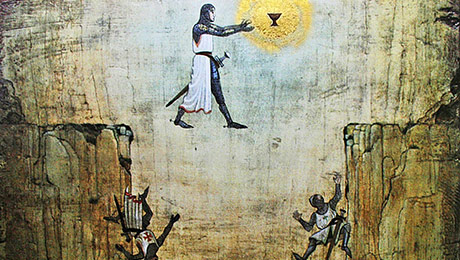
The commitment part of acceptance and commitment therapy can mean taking a leap into the unknown, very much like the heroes of ancient myths, and even modern day stories.
The first stage of the mythological journey—which we have designated the ‘call to adventure’—signifies that destiny has summoned the hero and transferred his spiritual center of gravity from the pale of his society to a zone unknown…[a] fateful region of both treasure and danger.
Joseph Campbell. The Hero with a Thousand Faces.
The job of the therapist is to create situations in which the clients engage in a leap of faith into a future that is unknown and—to the best they can tell—in the direction of their values. A leap of faith implies the willingness to have whatever happens when one makes that leap, to touch down wherever one lands.
Jason B. Luoma, Steven C. Hayes, and Robyn D. Walser. Learning ACT: An Acceptance & Commitment Therapy Skills-training Manual for Therapists.














 thefictiontherapist.com