The agony of breaking through personal limitations is the agony of spiritual growth. Art, literature, myth and cult, philosophy, and ascetic disciplines are instruments to help the individual past his limiting horizons into spheres of ever-expanding realization.’
Joseph Campbell. The Hero with a Thousand Faces
‘We thrill in watching a superb performance, whether athletic or artistic, because it allows us to participate in the magic of true mastery, to be uplifted, if only briefly, and perhaps to share in the intention that each of us, in our own way, might touch such moments of grace and harmony in the living of our own lives.’
Jon Kabat-Zinn. Wherever You Go, There You Are: Mindfulness Meditation in Everyday Life.
* In a series of posts I call mythology Monday, I look at quotes from the work of mythologist Joseph Campbell and consider them alongside extracts from books and papers on acceptance and commitment therapy (ACT) and related publications.
And his life was now, he felt, one monumental unreality, in which everything that did not matter – professional ambitions, the private pursuit of status, the colour of wallpaper, the size of an office or the matter of a dedicated car parking space – was treated with the greatest significance, and everything that did matter – pleasure, joy, friendship, loved – was deemed somehow peripheral.”
Richard Flanagan. The Narrow Road to the Deep North.
“When you hear ‘She is very successful’ or ‘He’s made a success of himself’, what does that conjure up for you? Our society generally defines success in terms of achieving goals: fame, wealth, status and respect; a big house, a luxury car, a prestigious job, a huge salary. When people achieve these things, our society tends to label them as ‘successful’. But if we buy into this popular notion of success, we set ourselves up for a lot of unnecessary suffering.
How so? Well, this view of success inevitably pulls us into the ‘goal-focused life’, where we are always striving to achieve the next goal. We may strive for more money, a larger house, a better neighbourhood, smarter clothes, a slimmer body, bigger muscles, more status, more fame, more respect and so on. We may strive to win this game or tournament, or make that sale, or get that promotion, or win that contract, or find a more attractive partner, or buy that smart car, or get that qualification, or earn that university degree. And the illusion is, ‘When I achieve this goal, then I will be successful.’
There are at least three big problems associated with going through life this way. First, there’s no guarantee you will achieve those goals, or they may be a long way off – which leads to chronic frustration and disappointment. Second, even if you do achieve them, they will not give you lasting happiness; usually they give you a brief moment of pleasure, satisfaction or joy – and then you start to focus on the next goal. Third, if you buy into this notion of success, it will put you under tremendous pressure – because you have to keep on achieving and achieving to maintain it.’
Totem, tribal, racial, and aggressively missionizing cults represent only partial solutions of the psychological problem of subduing hate by love; they only partially initiate. Ego is not annihilated in them; rather, it is enlarged; instead of thinking only of himself, the individual becomes dedicated to the whole of his society. The rest of the world meanwhile (that is to say, by far the greater portion of mankind) is left outside the sphere of his sympathy and protection because outside the sphere of the protection of his god. And there takes place, then, that dramatic divorce of the two principles of love and hate which the pages of history so bountifully illustrate. Instead of clearing his own heart the zealot tries to clear the world. The laws of the City of God are applied only to his in-group (tribe, church, nation, class, or what not) while the fire of a perpetual holy war is hurled (with good conscience, and indeed a sense of pious service) against whatever uncircumcised, barbarian, heathen, “native,” or alien people happens to occupy the position of neighbor.
The world is full of the resultant mutually contending bands: totem-, flag-, and party-worshipers. Even the so-called Christian nations—which are supposed to be following a “World” Redeemer-are better known to history for their colonial barbarity and internecine strife than for any practical display of that unconditioned love, synonymous with the effective conquest of ego, ego’s world, and ego’s tribal god, which was taught by their professed supreme Lord: “I say unto you, Love your enemies, do good to them which hate you.’
Joseph Campbell. The Hero with a Thousand Faces
‘Imagine you live in a small country that shares a border with a hostile neighbour. There is long-standing tension between the two countries. The neighbouring country has a different religion and a different political system, and your country sees it as a major threat. There are three possible scenarios for how your country can relate to its neighbour.
The worst-case scenario is war. Your country attacks, and the other one retaliates (or vice-versa). As both countries get pulled into a major war, the people of both nations suffer. (Think of any major war, and the huge costs involved, in terms of life, money and wellbeing.)
Another scenario, better than the first but still far from satisfactory, is a temporary truce. Both countries agree to a cease-fire, but there is no reconciliation. Resentment seethes beneath the surface, and there is the constant underlying threat that war will break out again. (Think of India and Pakistan, with the constant background threat of nuclear war, and the intense hostility between Hindus and Muslims.)
The third possibility is genuine peace. You acknowledge your differences, and allow them just to be. This doesn’t get rid of the other country, nor does it mean that you necessarily like it or even want it there. Nor does it mean that you approve of its politics or religion. But because you’re no longer at war, you can now use your money and resources to build up the infrastructure of your own country, instead of squandering them on the battlefield.
The first scenario, war, is like the struggle to get rid of unwanted thoughts and feelings. It’s a battle that can never be won, and it consumes a huge amount of time and energy.
The second scenario, a truce, is definitely better, but it’s still a long way from true acceptance. It’s more like a grudging tolerance; there’s no sense of moving forward to a new future. Although there is no active warfare, the hostility remains, and you are resigned to the ongoing tension. A grudging tolerance of thoughts and feelings is better than an outright struggle, but it leaves you feeling stuck and somewhat helpless. It’s a sense more of resignation than of acceptance, of entrapment rather than freedom, of being stuck rather than moving forward.
The third scenario, peace, represents true acceptance. Notice that in this scenario your country doesn’t have to like the other country, approve of its being there, convert to its religion, or learn to speak its language. You simply make peace with them. You acknowledge your differences, you give up trying to change their politics or religion, and you focus your efforts on making your own country a better place to live. It’s the same when you truly accept your uncomfortable thoughts and feelings. You don’t have to like them, want them, or approve of them. You simply make peace with them and let them be. This leaves you free to focus your energy on taking action—action that moves your life forward in a direction you value.’
* In a series of posts I call mythology Monday, I look at quotes from the work of mythologist Joseph Campbell and consider them alongside extracts from books and papers on acceptance and commitment therapy (ACT) and related publications.
Despite his reputation as a rogue, Ernest Hemingway advocated mindful techniques for writing and for living, and he offers good advice on how to be considerate to others.
When people talk listen completely. Donʼt be thinking what youʼre going to say. Most people never listen. Nor do they observe. You should be able to go into a room and when you come out know everything that you saw there and not only that. If that room gave you any feeling you should know exactly what it was that gave you that feeling. Try that for practice. When youʼre in town stand outside the theatre and see how people differ in the way they get out of taxis or motor cars. There are a thousand ways to practice. And always think of other people.’
‘With mindful attention, we bring a nonjudging, open attitude to our experience. We also refer to this way of relating to feelings and thoughts as acceptance, defined as opening to up and allowing your experience to be exactly as it is, without trying to avoid it, escape it or change it.’
Jan E. Fleming and Nancy L. Kocovski. The Mindfulness and Acceptance Workbook for Social Anxiety and Shyness – Using Acceptance and Commitment Therapy to Free Yourself from Fear and Reclaim Your Life.
Our conscious views of what life ought to be seldom correspond to what life really is. Generally we refuse to admit within ourselves, or within our friends, the fullness of that pushing, self-protective, malodorous, carnivorous, lecherous fever which is the very nature of the organic cell. Rather, we tend to perfume, whitewash, and reinterpret; meanwhile imagining that all the flies in the ointment, all the hairs in the soup, are the faults of some unpleasant someone else.’
Joseph Campbell. The Hero with a Thousand Faces
‘Blame is usually about making the other person wrong. Is this really useful to or working for you? While blame can be very effective and appropriate in a court of law, it most often brings unnecessary suffering to the realm of interpersonal relationships. In fact, there is a saying that holding onto resentment is like drinking poison and hoping the other person will die.’
Victoria M. Follette and Jacqueline Pistorello. Finding Life beyond Trauma: Using Acceptance and Commitment Therapy to Heal From Post-Traumatic Stress and Trauma-Related Problems.
* In a series of posts I call mythology Monday, I look at quotes from the work of mythologist Joseph Campbell and consider them alongside extracts from books and papers on acceptance and commitment therapy (ACT) and related publications.
Sometimes we invent stories, often brilliant stories, to avoid something in our lives. To get on with what you should be doing, it helps to see these excuses for what they are, just stories.
One of my favorite forms of resistance is sitting down to write and suddenly getting an idea for another screenplay—a much better idea, an idea so unique, so original, so exciting, you wonder what you’re doing writing this screenplay. You really think about it. You may even get two or three “better” ideas. It happens quite often; it may be a great idea, but it’s still a form of resistance! If it’s really a good idea, it will keep. Simply write it up in a page or two, put it in a file marked “New Projects,” and file it away. If you decide to pursue this new idea and abandon the original project, you’ll discover the same thing happening; When you sit down to write, you’ll get another new idea, and so on and so on. It’s a form of resistance; a mind trip, a way of avoiding writing. We all do it. We’re masters at creating reasons and excuses not to write; it’s simply a barrier to the creative process. So, how do you deal with it? Simple. If you know it’s going to happen, simply acknowledge it when it does. When you’re cleaning the refrigerator, sharpening pencils, or eating, just know that’s what you’re doing: experiencing resistance! It’s no big thing. Don’t put yourself down, feel guilty, feel worthless, or punish yourself in any way. Just acknowledge the resistance—then move right through to the other side. Just don’t pretend it’s not happening. It is! Once you deal with your resistance, you’re ready to start writing.
Syd Field. Screenplay: The Foundations of Screenwriting.
‘Since childhood you’ve heard, ‘Don’t believe everything you read.’ When we read about celebrities in the tabloids, we know that many of the stories are false or misleading. Some are exaggerated for effect, others are made up entirely. Now some celebrities take this in their stride; they accept it as part of being famous and don’t let it get to them. When they notice ridiculous stories about themselves, they just shrug it off. They certainly don’t waste their time reading, analysing and discussing them! Other celebrities, though, get very upset about these stories. They read them and dwell on them, rant and complain, and lodge lawsuits (which are stressful and eat up a lot of time, energy and money).
‘Defusion allows us to be like the first set of celebrities: the stories are there, but we don’t take them seriously. We don’t pay them much attention, and we certainly don’t waste our time and energy trying to fight them. In ACT we don’t try to change, avoid or get rid of the story. We know how ineffective that is. Instead we simply acknowledge: ‘This is a story.’
Russ Harris. The Happiness Trap: How to Stop Struggling, Start Living
Wars and temper tantrums are the makeshifts of ignorance; regrets are illuminations come too late. The whole sense of the ubiquitous myth of the hero’s passage is that it shall serve as a general pattern for men and women, wherever they may stand along the scale. Therefore it is formulated in the broadest terms. The individual has only to discover his own position with reference to this general human formula, and let it then assist him past his restricting walls. Who and where are his ogres”? Those are the reflections of the unsolved enigmas of his own humanity. What are his ideals’? Those are the symptoms of his grasp of life.
Joseph Campbell. The Hero with a Thousand Faces
If you were on a bus trying to go east in a maze of dirt roads in a large valley, you might not be able to tell your direction from moment to moment. If someone took a series of snapshots, sometimes the bus might be facing north, or south, or even west, even though all the while this is a journey to the east.
Paths are not straight because obstacles sometimes prevent movement in the desired direction. A person who values creating a loving family may nevertheless have to go through a divorce. In that situation, the intention to be loving may be revealed only in limited ways, such as not establishing oppositions between yourself and your spouse that will negatively affect your children, or treating a soon-to-be ex-spouse fairly in the division of assets. Only over time will the underlying value become evident, like tracks left in the snow that show, even though the path is not straight, it is headed east.
Paths are also not straight because we are human. We may intend to go east, but our attention may wander, and we may find ourselves heading north. Someone in recovery from a drug addiction who values sobriety and helping others may still relapse. That person’s mind may be screaming, “See, you can’t go east! You are a liar and a failure! You can’t be trusted!” as if to say, “Because you are heading north, as usual, you cannot value heading east.” In such an instance, that person’s task will be to thank his or her mind, feel the sadness and pain that comes from relapse, and then turn and head east once again.
Steven Hayes & Spencer Smith. Get out of your mind and into your life: the new acceptance and commitment therapy.
* In a series of posts I call mythology Monday, I look at quotes from the work of mythologist Joseph Campbell and consider them alongside extracts from books and papers on acceptance and commitment therapy (ACT) and related publications.
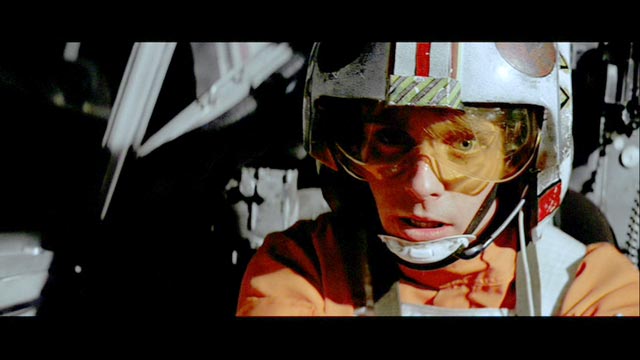
Language, like the Force in Star Wars, has a dark side. We have to learn to use it to our advantage, rather than let it use us.
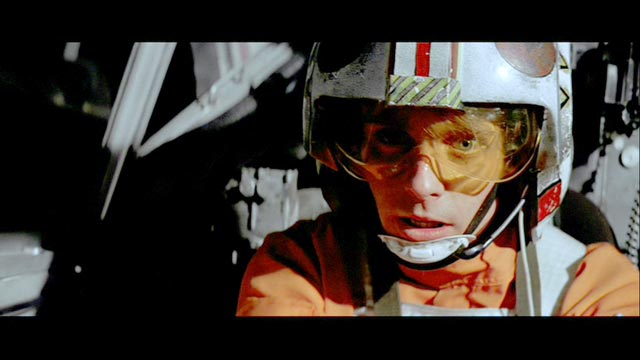
Luke Skywalker attacks the “Death Star,” a manmade fortress as huge as a planet. But it’s not fully constructed. A vulnerable slot lies open on one side of the sphere. Luke must not only attack into the slot, but hit a vulnerable spot within it. He’s an expert fighter pilot but tries without success to hit the spot. As he maneuvers his craft by computer, he hears the voice of Obi-Wan Kenobi: “Go with the Force, go with the Force.”
‘A sudden dilemma of irreconcilable goods: the computer versus the mysterious “Force.” He wrestles with the anguish of choice, then pushes his computer aside, flies by instinct into the slot, and fires a torpedo that hits the spot. The destruction of the Death Star climaxes the film, a straight action out of the Crisis.’
Robert McKee. Story: Substance, Structure, Style, and the Principles of Screenwriting
‘We cannot appreciate the human dilemma if we do not see the nature and speed of human progress clearly. Human misery can be understood only in the context of human achievement, because the most important source of each is the same: human symbolic activity. To borrow a phrase from the Star Wars trilogy, language is truly “The Force” in human progress. It is so enormously influential in human affairs because it has such a bright side.
‘But The Force has a dark side too. Psychotherapists know that side well. This dual nature of human language impacts not just at the level of the group—the human species or human civilization—but also at the level of the individual. Each individual has experienced both the bright and the dark side of The Force. To ask an individual human being to challenge the nature and role of language in his or her own behavior is tantamount to asking a carpenter to question the general utility of a hammer. But hammers are not good for everything, and language is not good for everything either. We must learn to use language without being consumed by it. We must learn to manage it rather than having it manage us. We must learn to overcome the dark side.’
Steven C. Hayes, Kirk D. Strosahl & Kelly G. Wilson. Acceptance and Commitment Therapy: An Experiential Approach to Behavior Change.
It’s easy to get an idea for writing, said playwright Lajos Egri. Find inspiration by taking a quiet moment to observe the world around you and within you.
To get an idea for any type of writing is the easiest thing. Look around you and be observant. Be observant and you will be forced to admit that the world is an inexhaustible pastry shop and you are permitted to choose from the delicacies the tastiest bits for yourself.
Lajos Egri. The Art of Dramatic Writing
‘The capacity to observe change is severely limited by the fact that much of our time is spent in incessant activity that does not provide a stable reference point. Encouraging “just sitting” is a simple way of quieting the body long enough so that that one’s focus can shift to other objects of consciousness, including the mind. Moving around and doing things requires a certain amount of cognitive processing capacity that tends to narrow the scope of attention to instrumental concerns. Sitting quietly, on the other hand, produces an interesting and somewhat paradoxical state of relaxed awareness, which in turn reduces cognitive demands and frees the resultant capacity for other purposes.
‘Quiet, relaxed awareness provides an ideal vantage point from which to observe change processes that are otherwise typically obscured. Manifestations are everywhere. Observation of the breath reveals phasic change from breathing in to breathing out. Observation of inner states reveals both regular and intermittent interoceptive sensations signifying a myriad of changes in underlying physiological processes. Observation of sights and sounds reveals a constant but often subtle flow of energy states captured by sense organs that are themselves constantly changing.’
Paul G. Salmon, Sandra E. Sephton, and Samuel J. Dreeben. Mindfulness-Based Stress Reduction. In Mindfulness in Cognitive Behavior Therapy: Understanding and Applying the New Therapies.














 thefictiontherapist.com